First Born emailed me the other day, asking why this Friday was going to be 'Wear your Rush t-shirt to work day'? As I was up to my oxters in a particularly knotty problem, I didn't reply immediately, and then promptly forgot about it. Oops.
A few days later, I was sat in a restaurant with Second Born (Our Lass being AWOL on yet another festive social occasion), and I remembered FB's question. SB just gave me a look (the one reserved for the merely unworthy rather than the full-on Queen of Scathe eye roll) and said "It's the 21st of December... as in 21/12... or even... 2112."
Doh!
How. Stupid. Am. I?
Cue sheepish text message to First Born.
For the uninitiated or just plain young, Rush are a Canadian rock band from w-a-a-y back, who are still going strong and selling out venues around the world. One of their most celebrated albums is 2112 from 1973, which inadvertantly launched the Starman logo, featuring a naked man and a five-pointed star. This isn't the time and the place for an in-depth discussion of the various pagan or Vetruvian Man connotations of this symbolism.
However... oddly enough, yesterday, during our monthly gathering at the local nature reserve, all manner of rustic and festive decorations were being hand-crafted to be sold as Christmas decorations. There were bunches of Holly, bouquets of sumptuous evergreen cuttings, Christmas wreaths and Stars of David woven from Willow and Dogwood. Not to be outdone, with half an eye on the more pagan roots of the Midwinter solstice (and with the thoughts of 2112 still fresh in my mind), I managed to fashion this festive decoration for Tense Towers.
Have a Happy Winter Solstice, er... Saturnalia... no, Dies Natalis Solis Invicti... I mean, Yule... look, please add your festival of choice and/or delete as applicable.
Catchy felicitation, eh?
Friday, 21 December 2012
Wednesday, 19 December 2012
The strange case of the [insert name of animal here] in the night time
Recently, a calm and reasonably dry evening (this is a weather report, not a continence statement) saw me deploying a wildlife cam at our local nature reserve.
I am not sure that I've yet discovered the secret of successful camera trapping. I seem to pick the wrong location for subjects, or a location with vegetation that triggers the camera continuously, or even the wrong weather.
But faint heart never won a fair maiden, as they say (though what they actually said was a whole lot ruder, as I recall, but you get the idea). So another attempt was ventured.
The camera was targeted on a chicane in the path, with a view of the bit between the two bends. In truth, the path at this point is also a causeway between two water bodies, a fact that will increase in prominence as this blogpost unfolds.
Having ensured that:
1. a memory card was installed;
2. said memory card was empty and formatted;
3. the batteries were fully charged;
4. the lens was clean;
5. the camera was secured firmly;
6. the camera was pointing in the correct direction;
7. there wasn't any vegetation likely to trigger the PIR unnecessarily;
8. I had uttered a silent prayer to whichever deity was on wildlife duty that day;
9. the camera was still pointing in the correct direction;
10. it was still night time and I hadn't wasted the whole evening messing about with points 1-9.
... I returned home.
Sixteen hours later, I was back on site for the retrieval mission. Well, one always hopes it will be a retrieval mission, rather than a forlorn searching in the undergrowth and a general rant about how you can't leave anything lying around these days that's not tied down. And it was tied down, so what did they think they were doing, the complete and utter b*st*rds etc.
Fortunately, the camera was still there, though a quick check of the image count showed a paltry 24 photos. As at least half of these would've been triggered by me when setting up beforehand and switching off the camera afterwards, it didn't seem like it had been a particularly fruitful night.
However, once the memory card was plugged into my pc, it became obvious that some wildlife had triggered the camera. And whilst the images weren't great (I'd set the sensitivity to Normal, when perhaps High would've been better), they did prove the presence of several species.
Shortly before 10pm, a Fox put in its first appearance.
Much later at nearly 3am, there appeared to be a Badger foraging by the bench.
But in between these times was the real surprise of the evening.
Either side of midnight, the camera was triggered by a creature that I was not expecting to be moving around during darkness...
A Mute Swan.
As mentioned earlier, the path is effectively a causeway at this point, so the swan was obviously shuffling from one water body to another. I suppose it could be in response to the fox's movements, though whether there's any danger for a swan if caught on land is debatable.
As one of my fellow bloggers remarked, "If you're up early, you're a lark. If you're up late, you're an owl. If you can't get to sleep, you're a swan!"
So all in all, it was an encouraging and educational experiment.
I am not sure that I've yet discovered the secret of successful camera trapping. I seem to pick the wrong location for subjects, or a location with vegetation that triggers the camera continuously, or even the wrong weather.
| Exhibit A, a whole load of nothing |
The camera was targeted on a chicane in the path, with a view of the bit between the two bends. In truth, the path at this point is also a causeway between two water bodies, a fact that will increase in prominence as this blogpost unfolds.
Having ensured that:
1. a memory card was installed;
2. said memory card was empty and formatted;
3. the batteries were fully charged;
4. the lens was clean;
5. the camera was secured firmly;
6. the camera was pointing in the correct direction;
7. there wasn't any vegetation likely to trigger the PIR unnecessarily;
8. I had uttered a silent prayer to whichever deity was on wildlife duty that day;
9. the camera was still pointing in the correct direction;
10. it was still night time and I hadn't wasted the whole evening messing about with points 1-9.
... I returned home.
Sixteen hours later, I was back on site for the retrieval mission. Well, one always hopes it will be a retrieval mission, rather than a forlorn searching in the undergrowth and a general rant about how you can't leave anything lying around these days that's not tied down. And it was tied down, so what did they think they were doing, the complete and utter b*st*rds etc.
Fortunately, the camera was still there, though a quick check of the image count showed a paltry 24 photos. As at least half of these would've been triggered by me when setting up beforehand and switching off the camera afterwards, it didn't seem like it had been a particularly fruitful night.
However, once the memory card was plugged into my pc, it became obvious that some wildlife had triggered the camera. And whilst the images weren't great (I'd set the sensitivity to Normal, when perhaps High would've been better), they did prove the presence of several species.
Shortly before 10pm, a Fox put in its first appearance.
Much later at nearly 3am, there appeared to be a Badger foraging by the bench.
But in between these times was the real surprise of the evening.
Either side of midnight, the camera was triggered by a creature that I was not expecting to be moving around during darkness...
A Mute Swan.
As mentioned earlier, the path is effectively a causeway at this point, so the swan was obviously shuffling from one water body to another. I suppose it could be in response to the fox's movements, though whether there's any danger for a swan if caught on land is debatable.
As one of my fellow bloggers remarked, "If you're up early, you're a lark. If you're up late, you're an owl. If you can't get to sleep, you're a swan!"
So all in all, it was an encouraging and educational experiment.
Saturday, 15 December 2012
Note to self: remember camera
Rather than participate in the frenetic whirl of activity that is generated by the rapidly disappearing number of shopping days to Christmas, we went for some fresh air down at HESC, our local nature reserve.
And I remembered my camera.
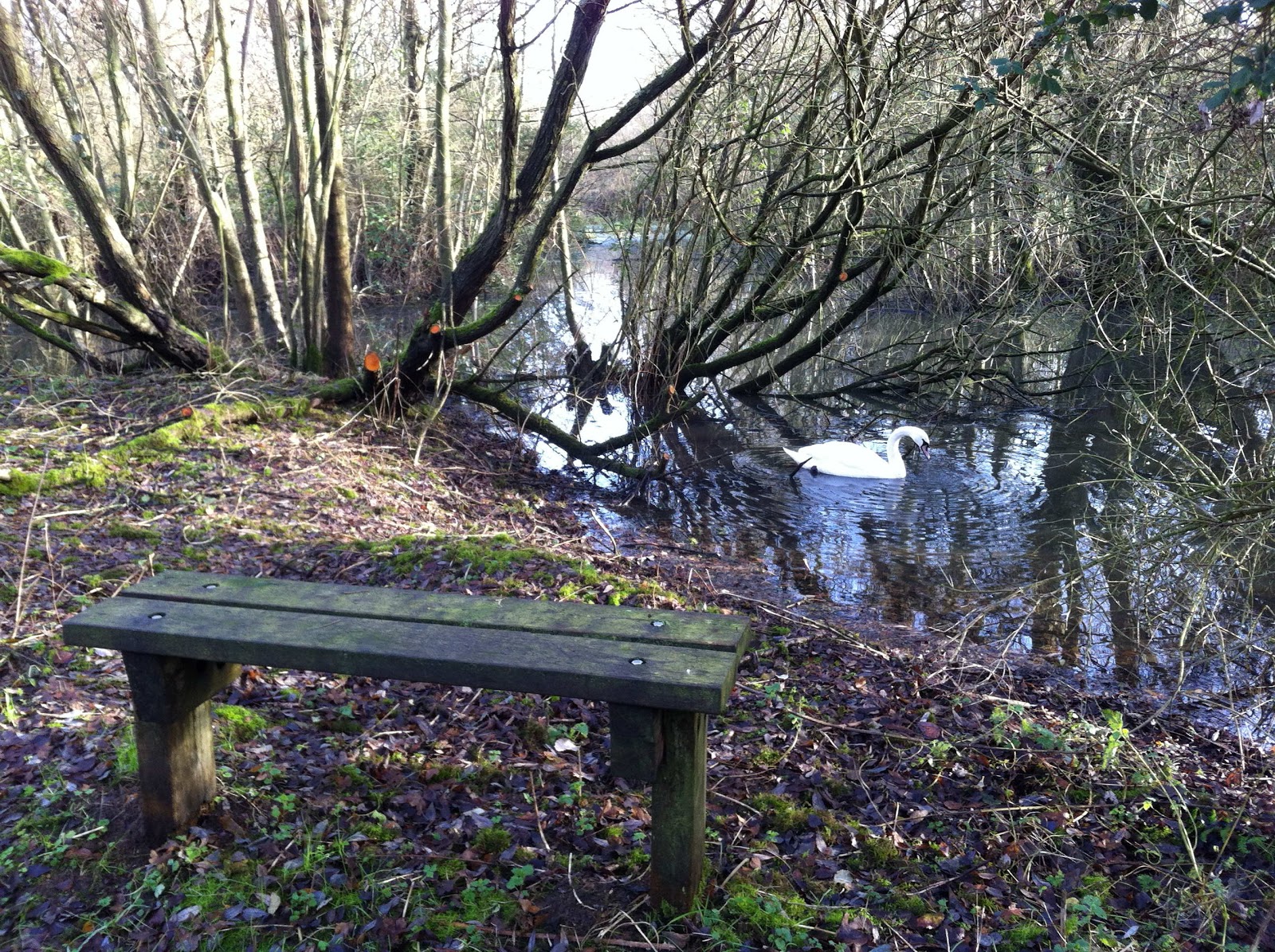
There was still plenty of water about the place and some of the multitude of Mute Swans have now taken to spending their time in the smaller pools, rather than out on the main lake.
With a bit more judicious pruning, there will be a fantastic view from this bench...
though not everyone was excited about that as I was.
The view from the Near Hide along the side of the main lake was one of dull and dreary Winter dampness.
Until, that is, I noticed what was happening to the Teasel heads...
Teasel babies!
Sunday, 9 December 2012
Back in the saddle
Ah, it felt good to be out in the fresh air again and mingling with the natural history. A crisp, bright morning, a little on the chilly side, but very welcome, nonetheless.
Wonderfully Oddly, the car park was barely half full. I guess everyone else was Christmas shopping in the cathedrals of commerce. By sheer chance, we walked into the cafe with four minutes to go before lunch was served, no queue at all and a tasty menu to peruse. Winner!
As we completed the circumnavigation of Eleven Acre Lake, the sun lit up the Cascade and brought back happy memories of warmer times and dragonflies aplenty. Sigh.
Taking the path along the western edge of Hawkwell Field, we climbed gently towards the Queen's Temple, stopping briefly to have a bijou pedantic rant about the sign shown below. I know what they meant but... Grrrr.
After looping around onto Lord Cobham's Walk, we passed his Pillar and then the Gothic Temple, before descending to cross the Palladian Bridge.
This is where we spotted the Goosander, four males and three females, in fantastic late afternoon sunshine and quite near for such shy ducks. Yeah, I didn't have my camera. Before we could approach the side of the lake, a few children began throwing sticks onto a patch of ice floating on the water. The ducks swam off hurriedly, but bunched together for safety. At this turn of events, dark thoughts entered my head about how hacked off I would've been had I been carrying my camera, but then an amazing thing happened and I had to issue a heartfelt, if inaudible, apology. During the breeding season, we don't see such numbers of Goosander in this part of the world, so it was most pleasing to watch as the males became a little territorial over the females, with much vocalising and throwing back of their heads. The ladies were having none of it, mind, but it was interesting to see and hear their behaviour.
Reason enough to return to the cafe for a celebratory mug of tea and a slice of cake?
Oh, I rather think so.
The priorities for the day were a walk and an eatery, so we chose Stowe Landscape Gardens as our destination, fifteen miles west of Tense Towers. However, our first port of call, en route, was Foxcote Reservoir, where a pair of Long-tailed Ducks had been seen for the previous two days. These sea ducks over-winter around the northern and eastern coasts of Britain, so we were surprised to hear of a sighting just about as far inland as its possible to be in the UK.
The reservoir was as full as I have ever seen it, but bear in mind that I usually visit in the middle of the dragonfly season, so this wasn't a huge surprise. The first seasonal wildfowl we spotted upon opening the hide hatches was a male Goosander, his white plumage almost glowing in the morning sunlight. A few Goldeneye were present too, but we couldn't pick out the Long-tailed Ducks amongst the more usual Wigeon, Tufted Duck, Pochard, Teal, Mallard and Great Crested Grebes. Fortunately, help was at hand. Another visitor to the site had been diligently searching for them for several hours and had located the pair way, way, way across the other side of the reservoir, diving for food and hidden by a multitude of Wigeon. Our bins could just about make them out as two tiny shapes of a different pattern and colour to the surrounding duckage. Even deploying Very Wrong Len wasn't much of an improvement.
| Long (way away) - tailed Ducks |
After an hour of waiting hopefully for them to swim closer, we admitted defeat and resumed our journey to Stowe, with thoughts of a hot mug of tea very much in our minds.
Suitably fortified against the cold, we pottered into the gardens and around the lakes, discovering another seven Goosander in the process. For early afternoon, the shadows were already long, creeping inexorably across the ground and towards the night.
![]() |
| View across Octagon Lake with Stowe School on left |
Taking the path along the western edge of Hawkwell Field, we climbed gently towards the Queen's Temple, stopping briefly to have a bijou pedantic rant about the sign shown below. I know what they meant but... Grrrr.
![]() |
| Er... which way? |
![]() |
| Bridge in foreground, Gothic Temple on hilltop |
Reason enough to return to the cafe for a celebratory mug of tea and a slice of cake?
Oh, I rather think so.
Sunday, 25 November 2012
November in Little Linford Wood
Following days of heavy rain, I was expecting this post to be something of a dismal mudfest, but a brief window of sunshine appeared and gave everything a pick-me-up.
However, getting there wasn't straight forward. The Great Ouse had burst its banks and was happily acquainting itself with the whole of the flood plain, which meant that a few roads were closed as a precaution. Having negotiated this hurdle, we arrived at the wood to find the car park virtually full. Eh? What's all this? It turned out that today was a work party day for the BBOWT volunteers who help to manage and maintain the reserve.
Our chosen route didn't take us to the area of the wood where they were working, so the results of their handiwork will have to remain a discovery for a different day.
Plodding on, we found ditches that are usually empty, were full to the brim. The ground amongst the trees was waterlogged and, at the northern end of the wood, a stream had overflowed across the field to the woodland edge.
Left of centre in the above shot can be seen the old buildings where the Little Owl often roosts...
As we walked along the hedgerows on the west side of the wood, flocks of Redwing and Fieldfare flew overhead and a pair of Grey Partridges sprang up from under our feet and whirred across the field to disappear into a winter crop. Meanwhile, a Fox was busy sunning himself on a ridge in the next field.
Looking back towards the wood, we noticed that the predominantly deciduous nature of the trees had one rather obvious exception.
Now that most of the leaves have fallen from its neighbours' branches, this Pine adds a touch of greenery to proceedings.
Concern continues to grow regarding the impending likelihood of five wind turbines being sited to the west of Little Linford Wood. Several miles to the east, the existing installation at Petsoe End is clearly visible from the wood's car park, as the following photo shows.
Ugly, alien and unloved. Incessant noise, constant movement and downright unsightly.
![]() |
| There's even some water in the pond by the car park |
![]() |
| And a brilliant job they do too |
Plodding on, we found ditches that are usually empty, were full to the brim. The ground amongst the trees was waterlogged and, at the northern end of the wood, a stream had overflowed across the field to the woodland edge.
Left of centre in the above shot can be seen the old buildings where the Little Owl often roosts...
| But not today |
Looking back towards the wood, we noticed that the predominantly deciduous nature of the trees had one rather obvious exception.
Now that most of the leaves have fallen from its neighbours' branches, this Pine adds a touch of greenery to proceedings.
Concern continues to grow regarding the impending likelihood of five wind turbines being sited to the west of Little Linford Wood. Several miles to the east, the existing installation at Petsoe End is clearly visible from the wood's car park, as the following photo shows.
Ugly, alien and unloved. Incessant noise, constant movement and downright unsightly.
| Oh, and the wind farm |
Saturday, 24 November 2012
Chasing the dragon... again
It's that time of year again, when the northern hemisphere sees less of the Sun, thanks to the obliquity of the ecliptic. Rain clouds unveil their dull grey sheets and heavy curtains of wetness, whilst dreary days of miserable weather merge together like a suffocating blanket. It's the meteorological soft furnishing department from precipitation hell.
Yep, it's time for the annual ode audit, submitting my dragonfly records for 2012.
In the dry.
This has been the final flight season before the British Dragonfly Society publishes its next Atlas in 2013, so it's been my last chance to help add data to build up the national picture regarding the distribution of dragonflies and damselflies within these shores.
Despite the cold damp Summer, through the year I have achieved a reasonable total of twenty eight species, though not all of these were seen in Buckinghamshire, more's the pity.
From the very first damsel of the Spring (a Large Red in Carmarthenshire on April 3rd) to the last dragon of Autumn (a Migrant Hawker in Hertfordshire on November 11th), it has been a roller-coaster of a year. The damsel was the earliest I've seen by several weeks, whilst the Migrant was later than any of my previous Hawkers by five days.
In chasing these dragons, I've covered a fair bit of ground: as well as kicking off the year in Wales, I've ventured to the north west of Scotland to see Azure Hawker and Northern Emerald; Our Lass and I visited Norfolk and its eponymous Hawker in June; I stumbled upon my sole Beautiful Demoiselle of 2012 whilst working in Surrey; and we visited the English Marches in August for Black Darters. My notebook reckons that, all told, I've recorded Odonata in thirteen different counties this year, but that's still only tracking down about sixty per cent of the British list.
It would seem that I need to try harder. Oh well, next year...
Yep, it's time for the annual ode audit, submitting my dragonfly records for 2012.
In the dry.
This has been the final flight season before the British Dragonfly Society publishes its next Atlas in 2013, so it's been my last chance to help add data to build up the national picture regarding the distribution of dragonflies and damselflies within these shores.
Despite the cold damp Summer, through the year I have achieved a reasonable total of twenty eight species, though not all of these were seen in Buckinghamshire, more's the pity.
From the very first damsel of the Spring (a Large Red in Carmarthenshire on April 3rd) to the last dragon of Autumn (a Migrant Hawker in Hertfordshire on November 11th), it has been a roller-coaster of a year. The damsel was the earliest I've seen by several weeks, whilst the Migrant was later than any of my previous Hawkers by five days.
In chasing these dragons, I've covered a fair bit of ground: as well as kicking off the year in Wales, I've ventured to the north west of Scotland to see Azure Hawker and Northern Emerald; Our Lass and I visited Norfolk and its eponymous Hawker in June; I stumbled upon my sole Beautiful Demoiselle of 2012 whilst working in Surrey; and we visited the English Marches in August for Black Darters. My notebook reckons that, all told, I've recorded Odonata in thirteen different counties this year, but that's still only tracking down about sixty per cent of the British list.
| Variable Damselfly, Coenagrion pulchellum, Wicken Fen June 2012 |
Wednesday, 21 November 2012
Is it not written... ?
I don't know, dear reader, if you've ever taken the, er... time to read "Thief of Time" by (Sir) Terry Pratchett? In the Discworld canon, it's my favourite book, though, boy, does it have some stiff competition.
One of its leading characters is Lu Tze, a "little, bald, yellow-toothed man with a wispy beard and a faintly amiable grin". Although he is a senior History Monk, he works as a lowly servant in the Monastery of Oi Dong, from whence comes his other name, Sweeper.
So when I recently found myself with a broom in my hand and a carpet of leaves to sweep, I could barely stifle the little chuckle that surfaced courtesy of Lu Tze. For everything is a test.
It was a glorious Autumn morning at Hanson Environmental Study Centre. Bright sunshine was streaming in on a low trajectory, intent on seeking out the frost which coated the leaves lounging in a thick layer on the boardwalk that crosses several ponds. My task was simple, clear the fallen detritus before the day's visitors ran the risk of going arse over apex on the slippery surface.
Beginning by the Near Hide, I hadn't cleared many yards of path, when I heard an unknown bird call. At a time of year when all the Summer visitors have migrated south and not all the Winter visitors have yet put in an appearance, I would've liked to think that I knew to what I was listening, but no, I did not. It was a bit like a Blackcap alarm call, but slightly more metallic, so I felt sure that it was still an alarm call of some sort. A movement caught my eye in a bush to the right of the boardwalk and a small bird could vaguely be seen hopping from branch to branch. A Robin normally frequents this area, but though the size was correct for that, the shape wasn't.
I leant on my broom, in what I forlornly hoped was a studious and thoughtful way, but no insight was forthcoming. After a while, the bird neared the edge of the bush, still apparently upset at my presence, and revealed a few precious details. Its outline was warbler-ish, a bit like a Blackcap, but the plumage on its upper parts was a rich brown rather than grey/brown. And it had a rounded tail. Ah, Cetti's Warbler! That explained the skulking in the bush, for these wee birds are notoriously difficult to spot. Pity I was without binoculars or camera!
After I had unsuccessfully tried to record the alarm call with my phone, the Cetti's flew off and I returned to my task, happier and more educated. Several yards of leaves later, the bird began calling again, but this time with the more usually heard Cetti's song, an explosive mixture of notes that probably make it the loudest bird in Britain (at least for its size).
I stared at the far side of the pond that was the source of the sound, but not a movement could be seen from the reeds and rushes, just the occasional blast of noise from a very secretive warbler.
Yep, it's in there somewhere...
Subscribe to:
Posts (Atom)
.jpg)


.jpg)

.jpg)


.jpg)