Showing posts with label Odonata. Show all posts

Wednesday, 29 July 2020

Like a Hole in the Head

The other day, I received a report of a damselfly in an odd location. The damselfly was in an odd location, not I. Looking up the supplied grid reference, I could see that the pool was very near the coast, but the species in question, Blue-tailed Damselfly, can stand a bit of brackish water by all accounts. The recorder also recommended that I wear wellingtons if I was going to plodge about there, as the pool was a bit smelly.

Monday morning, after a look at the week's weather forecast and a discussion with Eagle-eyed M, a decision was made to go and look NOW. The area was Rerwick Head in Tankerness, a place I had not previously frequented. Within a few minutes, we had found the pool, it had plenty of emergent vegetation, was popular (even on a cool blustery day) with craneflies and hoverflies, but very not with damselflies. The water was a thick brown colour, the mud smelly and not even a Blue-tailed Damselfly was going to call this home. We reckoned the sighting had been a fly-through, and we pottered off along the clifftops wondering what else was about.

Lots, as it turned out.

Every sheltered hollow had a few Common Blue butterflies and Meadow Browns. Several of the Browns were rather amorous.


On the cliffs, Black Guillemots were sat about, looking very dapper, making their shrill calls of sanguineous song. 


We followed the wildlife's lead and took shelter, sitting in one particular hollow to eat our lunch. The occasional Red Ant wandered over the rocks, and another tiny creature appeared on one of my wellington boots.


The pen is mightier than the sw-asp

It really was quite small! Unfortunately, from these photographs, it is impossible to ID the insect to species, or even Genus. However, according to the good people of the Bee, Wasp and Ant Recording Scheme, it is a chalcid wasp of the Family Pteromalidae. My curiosity always falls short of needing to take a specimen for ID purposes. In my book, the thirst for knowledge should not be blood-thirsty.


The hollow was by the Hole of Roe, a spectacular... er... hole in the cliff. It is about 15' high and 12' across and is 25' above beach level. The rocks here were quite different from elsewhere in Orkney. The cliffs were weathered in a way that made them look like mille-feuille pastry, whilst the rock surface undulated as if a series of waves had turned to stone. For the last 60 hours, I have had the strangest hankering for a large vanilla slice.

A gorge-ous day on Hoy

The forecast was a bit iffy, but for the last day of the 2020 National Dragonfly Week, Our Lass and I headed for the island of Hoy. I had not organised any official events this year due to pandemic restrictions, but the dragons and damsels don't know that! 

Large Red Damselfly

A recently-emerged Black Darter

Common Blue Damselflies in tandem

Black Darter

Black Darter

Emerald Damselfly (top) and Black Darter (bottom)

Emerald Damselfly

A distant dragon - Common Hawker

One of the pools on Wee Fea

Fledgling Cuckoo being fed by a Meadow Pipit parent

Coal Tit

A roadside Field Gentian

Field Gentian

Common Hawker

The Candle of the Burn of the Sale

The Burn of the Sale running through a gorge

Lunch in the rain

White-tailed Eagles (chick on left, adult on right)

Searching for Golden-ringed Dragonflies (unsuccessfully)

Grass of Parnassus

Tuesday, 21 July 2020

Eagles and dragons

With the further relaxation of restrictions in Scotland on the 15th July, it became possible for travel between the islands of the Orkney archipelago for non-essential reasons. Quite rightly, up until that date, the inter-island ferries and aircraft had been limiting passengers to key workers and the like. I won't be drawn into a discussion as to whether the chance of seeing a dragonfly for the first time in eleven months counts as 'essential', but Eagle-eyed M was sure that going to see the White-tailed Eagle chicks on Hoy before they fledged was nothing short of a national emergency.

So, on Saturday morning, Our Lass, M and I boarded the mv Hoy Head for the sailing to Lyness. As this was public transport, we were all sporting face masks of various kinds. Our plan for the day was quite flexible, because the weather of late has been a bit unpredictable and we couldn't be sure where the best spot for Odonata would be. However, as the time-sensitive part of the mission was '"Before the chicks fledge!", we headed straight for the Eaglewatch car park on the Rackwick Road.

For 2020, this pair of White-tailed Eagles has nested in the original nest from several years ago, rather than the one used in 2019. Either way, the distance from the car park to the cliff face of the Dwarfie Hamars is just over half a mile, making photography something of a challenge. As we were using a car, I had brought along my tripod, DSLR camera and Wrong Len, but the strong breeze still made this an interesting challenge. Tucking the tripod into the lee of the car, with one leg jammed between wheel arch and tyre seemed the most suitable option. Even so, the shots weren't great. Here's a couple of crops from the hour or so we spent there, staring into the sun and struggling to see the camera screen.

This is the nest site, an eagle chick is busy flapping its wings to exercise its flight muscles. Honestly! It's in the centre of the image, just below a white spot of lichen on the rock face.


In this second photo is an eagle which M saw flying in. It is perched just to the right of a small sunlit bush in the centre of the image. At the time, we couldn't be sure whether it was an adult or the other chick, but M contacted the local RSPB warden who was able to confirm that neither chick had yet fledged, and that sometimes only one can be seen on the nest, with the other tucked away at the back.


There were various options for good sites to look for dragonflies, but I will admit to feeling quite trepidatious, for as mentioned above, my odo diary indicated that it had been eleven months to the day since I had seen a dragonfly. No pressure. The strong breeze meant that the pools on Wee Fea would have no shelter at all for delicate aerial predators, nor indeed their prey. Similarly, the pools behind the beach at Rackwick would also be exposed to the full force of the wind. So we headed for a couple of pools adjacent to a burn which meanders out of this valley between Berriedale and the Red Glen.


I am biased, but I find this the most exhilarating view in Orkney.

Fortunately, where this burn meets the Rackwick Road, there was some shelter from the breeze and, within a few minutes, both Our Lass and M had spotted distant dragonflies hawking for smaller insects. Not so fortunately, this spot was at the tip of a meander, meaning that when the dragonflies landed on low vegetation to bask in the sun, they were out of sight to anyone foolhardy enough to struggle through chest high bracken with the aim of identifying said dragons. Apparently.

But I was keen for a close encounter, so I nipped over a few wooden bridges, along the road a short distance, then back to the valley on the opposite bank, which gave excellent views of a roosting male Common Hawker.


On the pool by the road, we also found a female Emerald Damselfly. Happy sigh.


At another pool across the other side of the island, Our Lass spotted a Black Darter, which didn't hang around for a photo. Here, also, was a colony of tiny mining bees of the Genus Andrena, busy little creatures which were difficult to capture on camera.


And as if to properly mark the occasion, we just had time to fit in coffee and cake at the island tearoom, which helpfully provided outside seating. With al fresco dining, the one casualty of the breeze was the froth of M's cappuccino.

Sunday, 12 July 2020

Up the stares and along a landing

It's been seven days since I last posted, but for once I can't blame a lack of muse, as there's five blogposts in draft from various goings-on and all manner of what-have-you. Between being out there doing stuff (work is slowly picking up again) and maybe a lack of motivation to be tippy-tappetting away at a keyboard, there has been a week's silence from Old Tense. One consequence of lockdown (and I will let you decide, dear reader, whether it is a favourable outcome), is that my nominal two posts a week target has been buried under a flurry of Tense Towers tales, such that we're several months ahead of schedule. And there's more local legends and parochial prattlings in the wings, pending a possible second wave of virusness. So, without further ado, let's begin catching up on recent events hereabouts.


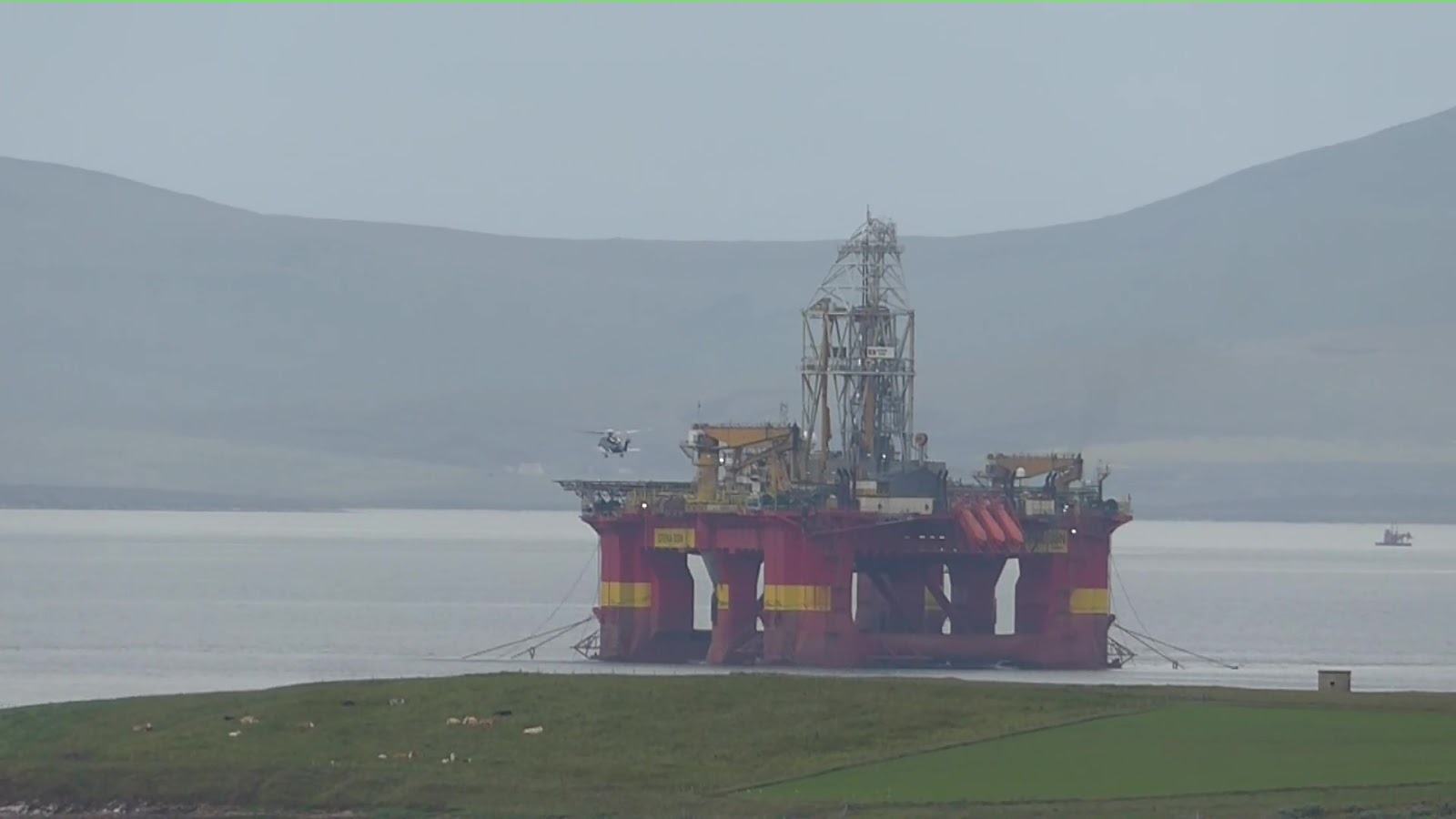
Last weekend, a third oil platform sailed into Scapa Flow and anchored off Howequoy Head. This is the Stena Don, a frequent visitor to Orkney when things are quiet in the spewing-forth-of-fossil-fuels business. It arrived with a complement of three ocean-going tugs which helped to tether the rig in position. Our corner of the Flow was busy that day, as there were also three freighters at anchor with no goods to ship anywhere.  

At one point, a helicopter landed on the Stena Don, and we wondered who was to-ing or fro-ing (if you're wondering, yes, I am on a bonus scheme with hyphens in this post). Later that day, there was a peculiar conjunction of two of the tugs, Njord Viking and Loke Viking, so we reckoned that the chopper must've been Dr Dolittle coming to see his Pushmi-Pullyu.


With all the staring out of the window, I noticed a tiny thing on the sill (well, apart from all the dust etc), but what it was, I couldn't begin to fathom. Shaped like a cartoon bone, purple with pale speckling, what the heck was it?


My best guess is some part of a flower?

Whilst I haven't seen a dragonfly so far this year, I was cheered up immensely by this rock engraving from Rob at Orkney Beach Craft.


Rob is now busy with a house name plate for us... with a difference.

Saturday, 4 July 2020

Muddy waters blues

It had been about a fortnight since the last visit to Russadale and the several dozen damselflies busying about their life cycles, so another trip was due to monitor any changes. Eagle-eyed M and I met up at Happy Valley, at the foot of Russadale, and quickly checked its pond for odes. There were a couple of Large Red Damselflies and about ten Blue-tailed Damselflies, some freshly-emerged, some overmature. At the time I remarked that this was the most populous I had seen the pond, so I couldn't wait to saunter up the hill to the quarry pools.

It really is a pleasant walk, between heather banks and verges of wild flowers, a little rough underfoot, but the climb is very gentle. Stonechats, Willow Warblers, Robins, Meadow Pipits and Wrens were all feeding young. Hoverflies and butterflies, a few moths and a bazillion other flying insects were all on the wing, as were a Hen Harrier and a Cuckoo.

When we arrived at the quarry, however, our mood darkened at the sight of virtually dry pools and an almost complete absence of damselflies. M spotted one fluttering up from the vegetation, a very fresh Blue-tail, and we mused that this could be last one emerging from the pools this year unless there's some prolonged spells of rain soon. There are dragonflies which breed here, whose flight season has not yet begun, so their larvae are stuck in the mud. I have no idea whether that is a survivable situation for Black Darters and Common Hawkers.


How and ever, not everyone was so distraught at the lack of water in the pools. A female Crane Fly was busy egg-laying into the mud. I have to admit to wincing whilst watching it.


Somewhat down-heartedly, we retraced our steps through the dale, musing upon the lack of rainfall and the natural processes of vegetative succession which were threatening this breeding site for at least four species of Odonata. Thankfully, Nature slowly worked its magic upon us, as the other wildlife of Russadale came to our rescue.

A Red-thighed St Mark's Fly

A female Common Blue butterfly

Valerian fit to burst

Ta Dah!

Oh, that conjunction of red flower bud and green ferniness

Slender St John's-wort

A Meadow Brown butterfly

A male Common Blue butterfly

Blue boys on Valerian

Oh!

Another male Common Blue butterfly
Since that visit on Thursday, and as I type this now, it has rained and is forecast to continue for much of the weekend. I can only hope for sufficient precipitation to recover the situation (with apologies to all the local farmers trying to cut hay for fodder and silage).