Showing posts with label Lepidoptera. Show all posts

Sunday, 9 August 2020

Cliff and the Archangels

It was time.

Time to revisit a coastal walk which I had previously only done in Winter, when the Grey Seals are pupping or when the low sunlight illuminates the scenery in a golden glow.

It is suitably different in Summer, though not necessarily drier or less windy.

This is the bay of Bur Wick in South Ronaldsay. The plan was to venture northwards up the west coast of the island until we (Eagle-eyed M and I) came to the place we reached during our southerly jaunt from Sandwick earlier in the year.  

As we found during that previous walk, there were many Common Blue butterflies frequenting the hollows and sheltered spots of the clifftops. Mostly males looking for love, as the females made themselves scarce. We were fortunate to find this little lady who allowed me to edge closer for a photo opportunity.
The clifftops were covered in mini-forests of Angelica Angelica archangelica which in turn were covered in all manner of insects, including bumblebees, honey bees, social wasps, solitary wasps, hoverflies and craneflies. I failed to adequately capture the wider Angelica scene, but spent ages oo-ing and ah-ing over various waspish delights. Here is a Maritime Mason-wasp Ancistrocerus scoticus.
A kerfuffle inland drew our attention, as a Great Black-backed Gull and a Great Skua (Bonxie) had a bit of a stand off over some alleged slight, possibly involving one looking at the other in a funny way.
The cliffs along the route are spectacular, not terrifically high, but the rock strata are very interesting, with different coloured layers and all sorts of whorls and scrunches (technical geological term).
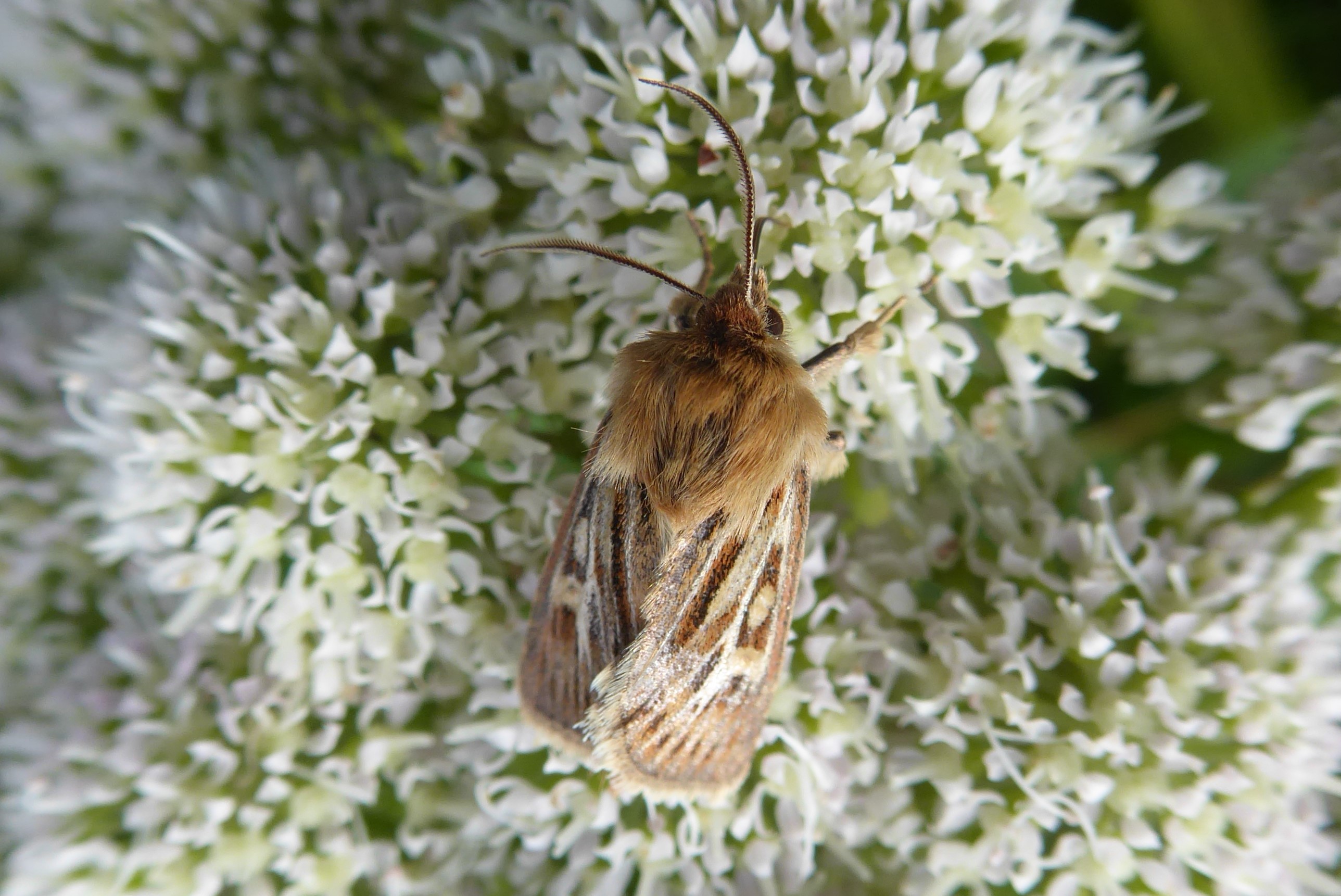
Amongst the heather and crowberry, we kept seeing examples of this moth, but had no idea what it was at the time. Recourse to an ID guide later, proved it to be an Antler Moth.
These beasties are Dagger Flies of some stripe, but didn't both us at all, unlike the clegs, midges and Red Ants (when we stopped for lunch, M managed to park herself on top of an ant colony). 
All the while, the seas of the Pentland Firth pounded the coast. OK, 'pounded' might be over-egging the conditions on a Summer's day, but the scenery bears witness to wilder times on these shores.
During our return to where we had parked, the insects feeding on the Angelica florets were as abundant as ever. This is a hoverfly Scaeva pyrastri...
and we found another Antler Moth.
Nearing Bur Wick once more, an oil tanker was sailing into the Firth, en route to a ship-to-ship otransfer in Scapa Flow. It can be seen in the distance, navigating between the Lother Rock and the Pentland Skerries.


An unexpected insect to be found in the 'canopy' of the Angelica forest was this Earwig. Now that I look at the photo again, I suppose there is a passing resemblance of the floret to an Elizabethan wig.  
And we also managed to find the other species of mason-wasp which is present in Orkney, the Stocky Mason-wasp Ancistrocerus oviventris.
The only social wasp we saw was this Tree Wasp.

Eight months ago, M had a fall on this walk, necessitating a trip to A&E, so I think it was good for her to lay that particular ghost to rest. In fact, at the place in question, she was able to take some photos of a Small Tortoiseshell, which was basking on the warmth of a piece of wood.

Thursday, 6 August 2020

Check his underwear!

Remember this rather worn and drab moth from the previous post which I found on the wall of Tense Towers? Well, the county Lepidoptera recorder for Orkney persevered with it, asked for more and better photos (I could only provide more and worse ones), then he called in help from another expert, and they have come up with an ID.

It's a male Satin Beauty Deileptenia ribeata. This is the first record of the species in Orkney. As they say around here, I am some chuffed. 

Wednesday, 5 August 2020

Lovely leps and rocky ramblings

Last weekend was spent gardening and wildlife watching, in equal measure. Sometimes both together. The previous weekends had been taken up with trips to the island of Hoy to see some dragons, so our 'estate' was in a bit of a state and required some TLC.

In fact, even without the trips to Hoy, I had run out of metaphorical spoons with the garden. After all the effort put in during lockdown, and the huge strides made in various projects (some even to... [gasps]... fruition), the mess created in repairing the soakaway had rather taken the shine off all we had achieved. I was ignoring the garden to Olympic standard.

But, as time and tide wait for no man (and I'm sure that Dame Ellen MacArthur would have an opinion on that), the trusty sward at Tense Towers is similarly impatient of temporal and gravitational boundaries. So, something had to be done.

After topping up the fuel tank of the lawn mower, I was trundling the machine around to the rear of the property, when I spied a moth tucked away at the bottom of the harling on the front of the house.


In its way, it was quite well camouflaged. Unfortunately, it was very worn, so a definite ID will likely prove impossible, but the contenders are Willow Beauty or Mottled Beauty.

When I finally began mowing, I disturbed several freshly-emerged Large Yellow Underwing moths, though was unable to capture the striking splash of colour from the underwing in a photograph.


After mowing, and during a spot of weeding, a Small Tortoiseshell butterfly paid us a visit. Well, to be fair, it was actually visiting all the pale yellow brassica flowers it could find. And we have a few...


In the afternoon, I took Our Lass to Rerwick Head, to explore more of the area visited earlier that week. 

Sea Spleenwort

A tiny rock pool

A wasp mimic, the hoverfly Sericomyia silentis

A pair of Common Blue butterflies mating

A gathering of Shags

Heber Geo, a sea cave open at both ends

It was a hot day to be a bundle of fluff like this young Fulmar chick

A colony of Kittiwakes with many youngsters

A Middle-barred Minor moth (Thanks to AF for the ID)

Wednesday, 29 July 2020

Like a Hole in the Head

The other day, I received a report of a damselfly in an odd location. The damselfly was in an odd location, not I. Looking up the supplied grid reference, I could see that the pool was very near the coast, but the species in question, Blue-tailed Damselfly, can stand a bit of brackish water by all accounts. The recorder also recommended that I wear wellingtons if I was going to plodge about there, as the pool was a bit smelly.

Monday morning, after a look at the week's weather forecast and a discussion with Eagle-eyed M, a decision was made to go and look NOW. The area was Rerwick Head in Tankerness, a place I had not previously frequented. Within a few minutes, we had found the pool, it had plenty of emergent vegetation, was popular (even on a cool blustery day) with craneflies and hoverflies, but very not with damselflies. The water was a thick brown colour, the mud smelly and not even a Blue-tailed Damselfly was going to call this home. We reckoned the sighting had been a fly-through, and we pottered off along the clifftops wondering what else was about.

Lots, as it turned out.

Every sheltered hollow had a few Common Blue butterflies and Meadow Browns. Several of the Browns were rather amorous.


On the cliffs, Black Guillemots were sat about, looking very dapper, making their shrill calls of sanguineous song. 


We followed the wildlife's lead and took shelter, sitting in one particular hollow to eat our lunch. The occasional Red Ant wandered over the rocks, and another tiny creature appeared on one of my wellington boots.


The pen is mightier than the sw-asp

It really was quite small! Unfortunately, from these photographs, it is impossible to ID the insect to species, or even Genus. However, according to the good people of the Bee, Wasp and Ant Recording Scheme, it is a chalcid wasp of the Family Pteromalidae. My curiosity always falls short of needing to take a specimen for ID purposes. In my book, the thirst for knowledge should not be blood-thirsty.


The hollow was by the Hole of Roe, a spectacular... er... hole in the cliff. It is about 15' high and 12' across and is 25' above beach level. The rocks here were quite different from elsewhere in Orkney. The cliffs were weathered in a way that made them look like mille-feuille pastry, whilst the rock surface undulated as if a series of waves had turned to stone. For the last 60 hours, I have had the strangest hankering for a large vanilla slice.

Monday, 20 July 2020

Edgy

Friday saw me joining in a walk on the west coast of West Mainland. Here there are quiet coves of calm water...


and geos with crashing Atlantic breakers.


On the maritime heath of the clifftops, there are swathes of Eyebright.


And above the turbulent tumult of the geos, there are seabirds a plenty. This is a Black Guillemot (Tystie).


Did I mention crashing waves?


A clump of Wild Thyme on the cliff edge of another geo.


A pair of Common Blue butterflies were mating on the bank of one of the many burns which flow off the heath and over the cliff edge.


Also by the burns and in wet flushes, were small colonies of Bog Pimpernel, such a gorgeous wee thing.


It's that time of year when the Fulmar chicks are just cute bundles of fluff.


And occasionally, there's an opportunity to spend some time in the company of...

Puffins!


This is a rock stack known as North Gaulton Castle. 


On the way back, there were more Puffins.


Whilst the rest of the group were looking for wild flowers, I spotted a few mason wasps, which I think are Ancistrocerus scoticus.


The wet flushes of the heath also contained much Bog Asphodel, adding a splash of colour to the landscape.


Try as we might, this butterfly wasn't keen on being photographed, so I had to make do with a distant shot. Later, we worked out that it was a Large Heath, which made sense bearing in mind the habitat. It wasn't very big, but is bigger than a Small Heath (which we don't have in Orkney).


And there was just time for one more gratuitous photo of rugged cliffs, crashing waves and turquoise seas.