Thursday, 3 April 2014

Willow and dark sarcasm

Updated 7th April 2014 with additional species information

http://en.wikipedia.org/wiki/File:WillowRosenberg.jpg
Sorry, Buffy the Vampire Slayer and Alyson Hannigan fans, not this Willow, I'm afraid. And very specific apologies to Captain Sundial, who is still carrying a torch after all these years.

Nope, this blogpost is about Salix and my first tentative steps at planting up our garden. The first watch words in Orcadian gardening are 'shelter belt', to provide conditions for other plants to grow. In some ways, this is like choosing a sacrificial lamb (o-oh, veering Buffy-wards again!) to take the brunt of the prevailing winds and the most obvious candidate is Willow. Opinion is divided upon whether it is the best provider of shelter, but it's certainly the cheapest to source and easiest to plant.

Following my trip to Orkney ZeroWaste's Spring Fair and Plant Sale last month, I was the proud owner of 160 cuttings of what I think is Grey Willow, Salix cinerea, one of the native Orkney willows. (7th April 2014. See note below for further clarification, Thanks again Jenny!) 


Here's one of several bundles, keen to bud
But first there was the small matter of preparing the ground. In an ideal world, the whole half acre site would be weed and stone free. However, very little of that has yet occurred and the budding bundles of potential tree-ness won't wait forever.

So, putting all perfectionist and pedantic thoughts to one side, I roughly cleared a swathe 23m long and 0.5m wide. This was to make room for the first double row of planting, beginning in the bottom southern corner of the garden and progressing along the south-westerly boundary.

When I say 'roughly cleared', I meant removing the Docks. The Willow will have to take its chances with the dandelions, buttercups, various grasses, thistles and heaven knows what else. Well, they are native trees, so they must have got the hang of coping with this sort of stuff, you'd think?


What's up, Dock?


I do wonder if these have a use...
I decided to leave a significant gap between the first row and the boundary fence, so as to leave room for maintenance and restrict farm animals from grazing, hence the row was marked out 1.5m from the fence.
Doesn't look very promising, eh?


The first bundle is placed in position ready to be planted
The actual planting was reasonably easy, the instructions I was given were carried out to the letter...


This is my kind of gardening!


OK, Pink Floyd fans, think of it as another stick in the wall.
And just when you were wondering where the 'dark sarcasm' came in!

The cuttings went in at about 0.5m intervals and then the second row was planted 0.5m inboard of that, but offset by 0.25m.


Yeah, I know it's not straight. Jeez, lighten up!
On cue, as I hammered in the eighty-oddth stick, although not forecast, it began to rain. At least it saved me from pondering whether to water in the cuttings, or not.

The next step is to repeat the above, but along the south-easterly boundary, at which point I will have run out of cuttings. No worries, there's a plan...

Note: The cuttings I got at ZeroWaste were not native willows - the bundles contained mostly some of the biomass willows that were grown by Orkney College (fast growing Salix viminalis hybrids, long narrow leaved) plus maybe a few of the Salix hookeriana (which is a North American willow with wider silvery leaves). We wait with bated breath for growth and leafage, so that we can attempt to decipher the Salix code.

Wednesday, 2 April 2014

Death in paradise

It would seem that, even this far north, the Spring migration is well and truly under way. This is a good and pleasing thing.

Local birders have been reporting sightings of Hawfinch in a few gardens and the Bird Observatory on North Ronaldsay has experienced an increase in migratory species, blown across the North Sea on easterly winds.

However, it's all fairly quiet in our neck of the w.... er... dochans? Bare earth doesn't attract many birds and I don't think Stone Curlew make it to Orkney! I am starting to hear more territorial birdsong, but it is limited to a Blackbird and a Greenfinch. But being outside in the garden does allow sounds from farther afield to reach my ears. Whilst turning over the soil, I am accompanied by the calls of distant Oystercatcher and Lapwing. I never tire of hearing the skirling notes of the Curlew. Starlings chatter and mimic from their perches on the roofs of the nearby farm barns. An almost ever-present sound is the plaintive mewing of Common Gull, and occasionally but somewhat bizarrely, a Peacock, which seems to live somewhere to the east of us.

There's plenty of life in the soil too, which is a pleasant surprise. No shortage of earthworms and all manner of ground-dwelling invertebrates. I remarked upon this fact, this morning, whilst visiting the Scottish Natural Heritage (SNH) office in Kirkwall, only to be told that, in some parts of Orkney, the New Zealand Flatworm has decimated native earthworm populations. Crivens! We will have to be careful when moving new plants into the garden, to try to minimise the chances of accidentally bringing this alien predator to our doorstep.

I was also warned to keep an eye open for Stoats, because although they are seen infrequently, they are a fearsome predator of ground-nesting birds. Many of the species of birds that choose to rear their young in Orkney are already declining in numbers. The last thing they need is another mammalian egg and chick thief. Stoats are not native to Orkney and are likely to have been introduced, either accidentally or misguidedly. Hmmm, one creature's island paradise is definitely another's nightmare from hell.

Tuesday, 1 April 2014

Dochans

Shhhh! The weather has been reasonably dry for nearly a week! Still overcast and with a fair old breeze, but our half acre of mud is beginning to look more like a garden-in-waiting. Perhaps it was the subtle turning of the year as we passed the vernal equinox, but a gentle pressure drove me outside, like a new leaf bud, keen to burst into the Spring air.

It was time to dig.

There's a small patch of earth at the front of the property, maybe 20m by 2m, which looked as if it would be a good place to start. An attainable goal, I reckoned, for muscles that had forgotten what they were for and, conveniently, couldn't remember how back-breakingly achy turning over soil can be.

They soon found out!

We were well aware that the soil we could see would be a thin veneer over what had been, until recently, a building site. Sure enough, I began to unearth plenty of stones, so began to construct a cairn in the corner of the hard standing. The odd breeze block and kerb stone appeared, along with various bits of twisted metal. However, the predominantly, and overwhelmingly, main constituent of this garden is Dock, Rumex obtusifolius. This is a perennial weed with a deep tap root, so a long and uphill struggle (even on the flat bits) awaits me. It's not all bad news, as the leaves of the Dock are a useful tool in the natural First Aid kit against the stings of Common Nettle, Urtica dioica, which often grows in similar habitats.

So far, I have dug about a third of this small area, in short bursts of energy punctuated by vociferous complaints from my back. I have filled about six compost bags with Dock roots and made a decent start on the cairn.

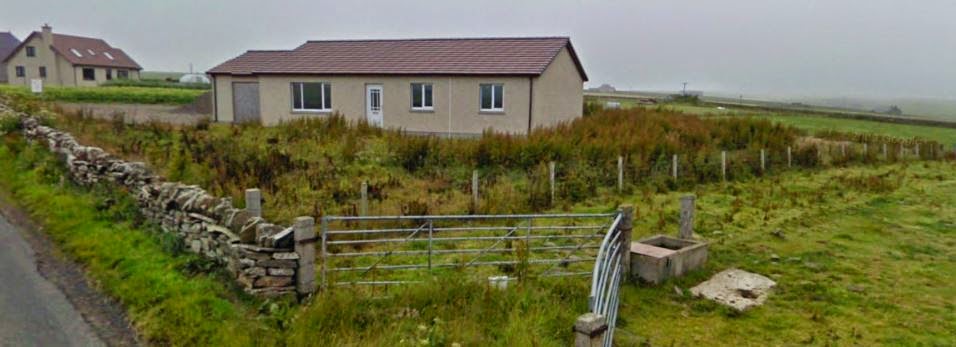
Recently, whilst on the internet, I discovered this photo of the garden, taken by Google Street View in 2009. Apart from realising that our 'new' home has been in existence, almost complete but empty, for five years, the other shock is the sheer amount of Docks present. And then some, allowing for another five years' spread!


The area behind the house is now populated by another four homes.

I wouldn't wish to give the impression that I spend an inordinate amount of time surfing the web, but today I quite coincidentally came across another blog, also written in Orkney, whose subject was Docks, or Dochans as they are known up here. It features some poems written about Dock, although I must admit that my feelings towards this plant haven't quite risen to the heights of rhyming self expression.

For those readers who are sharper than the average nettle sting, the previous blog in that series can be found here.

Monday, 24 March 2014

Shedding some light

Our Lass is currently away 'sooth', visiting The Two Ones and twitching rare bird species such as Magpie and Jay. As England is much nearer the Equator than Orkney, she has also mentioned that it's rather warm. This leaves me holding the fort on my own, or 'Gnome Alone' as one of my blogger colleagues calls it.

Fortunately, I haven't been bored or stuck for things to do. One of the many pleasant side effects of moving to this island community is that I have (and this will be hard to believe) developed a social life (see, I told you it was bordering on the incredulous). So last Friday I went to a very interesting talk by Eric Meek, arranged by the Orkney Field Club, which shed some light on the final season of a five year Scottish project to confirm and map the locations of dozens of species of plants. As you can probably imagine, the rarer plants tend to grow in some rather remote and stunning places, so the tale and accompanying slideshow were very enjoyable.

The following day, I drove across to the Stromness in West Mainland to attend a Spring Fair organised by Orkney ZeroWaste, a charity promoting the mantra Reduce, Recycle, Reuse. On the way there, I was fortunate to spot my first Short-eared Owl of the year (a proper definition of the abbreviation SEO, rather than all that Search Engine Optimisation malarkey). The main reason for the trek over to the diametrically opposite side of Scapa Flow was that there was a plant sale at the Fair. In fact, not just any plants, specifically trees.

Our Lass is keen to begin planting shelter belts in and around our half acre of mud, to provide windbreaks for less hardy things, like cornfield annuals and me. To this end, before she left for the sooth, I was entrusted with a shopping list and a budget.

Another blogger, Sian from Life on a Small Island, had tipped me off that the lady I needed to speak to was called Jenny, who is a bit of a tree expert. On arriving at the Town Hall, it was immediately obvious who Jenny was, as she was stood behind several tables laden with all manner of native Orkney saplings. I patiently queued for a chance to ask Jenny's advice and when I was able to introduce myself, she remarked that she knew who I was because our neighbours had told her. Orkney is not a place to keep secrets!

With Our Lass's list and Jenny's sage counsel, I was able to select 24 saplings of 6 species, as well as 80 Willow cuttings for the south easterly perimeter. There was one tricky moment when I couldn't read my nearest and dearest's writing, so had to choose between Alder and Elder.

All that retail therapy was thirsty work, but happily there was food available too. Before I ordered a light lunch, I was able to introduce myself to one of the caterers, Fay from The wind and the wellies blog. It was great to have a bit of a natter about our blogging experiences. The soup was very tasty, as were the cakes. 

Yesterday was much less eventful, spent at home putting up more pictures and photos on the walls. After a video chat with Our Lass, I went to bed quite early, to read for a while. I am re-reading Terry Pratchett's Snuff, a tale of slavery, drugs and oppression, which uses a race of goblins as the allegorical downtrodden masses. I put the light out at about 10pm, briefly woke up in pitch darkness at 1am and went straight back to sleep. When I awoke again, it was very bright and I dozily thought it was morning and I must have slept in. However, it suddenly dawned on me that my bedside light was on and it was only 4am. Odd, I mused, I must have knocked it in my sleep (it's a touch-activated device). But that didn't explain why Our Lass's bedside light was also on, which was most definitely out of my reach (it's a big bed, you see. In fact, so big we normally have to text each other "Good night").

Hmmm, it's the middle of the night and, bizarrely, our bedroom lights are switched on, all on their own. 

Spooky!

A swift tour of the house confirmed that everything was secure and nothing was missing. But it was a bit of a puzzle. As it proved impossible to get back to sleep, I spent some time interrogating the internet for an explanation. It would appear that touch-activated lamps can be triggered by a surge on the electricity supply, and I recall that this may have happened once before, many moons ago, but in the daytime.

I can vouch for the fact that it has much less impact in the daylight!

Saturday, 22 March 2014

The Victor Scale explained...

Everyone's heard of the Richter Magnitude Scale, developed by Charles Francis Richter, in 1935, to assign a single number to quantify the energy that is released during an earthquake.

However, not many people are aware of the Victor Scale used to quantify the sudden release of energy during a seismic rant at some unfairness or lack of service. The scale is named after the fictional character Victor Meldrew from the BBC TV series One Foot in the Grave. The identity of the originator of this measuring scheme must remain anonymous, so I'll just refer to him as John. 

Day after day, the scale was developed through a series of tirades against poor workmanship, shoddy customer service, unfathomable decisions from superiors and incompetent bungling by those in power.

Each logarithmic step in the scale is referenced to a quote from the grumpy and curmudgeonly Victor, as shown below:

Figure 1: The Victor Scale
Various additional steps can be added depending upon the level of frustration felt or whether the letter 'F' is still functioning on one's keyboard.

Thursday, 20 March 2014

To the power of four

Perhaps it is because we lived on Burray for two months, but one of the Churchill Barriers fascinates me. And it's not the ones that cause all the traffic problems when the wind, weather and waves combine. No, it's Barrier 4, which connects Burray with South Ronaldsay.

Recently, I was looking through a book of old photographs that I'd borrowed from the local library. Amongst all the interesting pictures of times past was this photograph...

Plate 137 from Images in Time (Orkney life through the lens of James W. Sinclair)
This image shows the newly-constructed Barrier 4 open to traffic for the first time. Several 'block' ships (the previous defence against a sea-borne attack) can be seen on the east side of the barrier, where they were scuttled to restrict access to Scapa Flow (now on the west side of the barrier).

The area looks very different now, not least because there are crash barriers to prevent vehicles falling into the sea. But more of the differences later.

With my appetite whetted, I searched for other images of the barrier on the web.

There is a site record on the webpage of the Royal Commission on the Ancient and Historical Monuments of Scotland, with five images taken at different times. This aerial photograph from the late 1940s shows the barrier and block ships from overhead.


The barrier is still a narrow causeway between the North Sea and Scapa Flow.

Contemporaneous with the above shots I can but assume, is this postcard which is now available on eBay.


One of the local ferry companies, Northlink, has a short article about the barriers on its website, where the image below can be found. Sadly, I do not have a date for this photo.


However, as can clearly be seen, not only has the power of the sea begun to break up the block ships, but a sandy beach has formed.

Probably from around the same time, a postcard was issued, also now available, like so much else, on eBay.


Moving forward in time to nearer the present, the road across the barrier was upgraded and fitted with crash fencing on the Scapa Flow side, as can be seen in this photograph from a genealogy page of the Cromarty and Ross family.


These days, the dune system on the east side of the barrier is still growing. and after south easterly storms, the sand has to be removed from the road. I nipped across to Burray this afternoon to try to recreate the first photograph at the top of the page. Coincidentally, a hailstorm was coming in from the west, so I didn't hang around long!


Finally, here's a shot from a different day, from the other end of the dunes and looking back to where the original photograph was taken, approximately right of centre where the small white building is located.


I find this dynamic landscape enthralling, that such a habitat can be formed within the span of a human lifetime. Where was the sand's original location? How has the movement from one place to another affected wildlife? Which reminds me, today was obviously a camera day, so no Snow Buntings. Gah!  

Sunday, 16 March 2014

Ploughing a colourful furrow

This is probably a sweeping generalisation, a lazy stereotypical swipe and a move guaranteed to drop me deep in the matrimonial mire...

I have long felt that when we choose a replacement car, Our Lass never worries about the make, the model, miles per gallon, engine size, resale value or even insurance group. She may fleetingly wonder about handbag storage, but only ever, ever, ever really considers colour.

To her credit, Our Lass takes my chromatic joshing in good spirit, so there's no great er... hue and cry. However, since moving to Orkney, this theory has taken on a life of its own.

As part of her job, she visits clients in their homes, which in Orkney is often the family farm. There has been an unlikely spin off from this. Through the toys of the many children she meets, Our Lass now knows some of the tractor manufacturers who grace the UK market... by colour.

Massey Ferguson = Red
JCB = Yellow
John Deere = Green
New Holland = Blue

Will there be pressure on me to find room on our drive for one of these vehicles? That would raise a few environmental concerns. Does that make me a Rainbow Worrier?