Saturday, 31 December 2011

Bund burning by the book

You may recall, dear reader, the photo from the Imperfect and Tense HESC page. No? Well, here's a little reminder. It shows a view across the bund, the low bank separating the two halves of the main lake of the nature reserve. The image was taken a year or so ago. On closer inspection, a Fox can be seen wandering along the bund, but the focus of this blog post isn't the fluffy mammal/evil egg thief/member of the canine family (delete as your emotional reaction is applicable), it's about the trees.

View looking north across bund
In fact, there shouldn't be any trees at all, lest they discourage any form of wading bird activity by their very presence or give cover to predators. For the bund should be a shingle bank for waders, an open landscape sitting low in the water, with muddy margins where the birds can feed in safety. A place where they can roost and lay their eggs and raise their broods successfully. So in a small way, this is about the Fox too.

View looking south across bund. Photo courtesy of The Admiral
As you can tell from the photos, the maintenance of this particular habitat was so far behind schedule, it was in danger of meeting itself coming the other way. Willow and Alder had colonised the area, and although the bund is surrounded by water, predators could easily swim to it, safe in the knowledge that their approach to ground nesting birds would be camouflaged to perfection.

The irony of the situation is that after this river valley site was worked for gravel extraction, it became a wildfowl sanctuary in 1970. A twenty year research project was then undertaken by the site owner, Amey Roadstone Construction (ARC) and the Game Conservancy. In 1992, the results of this project were published in 'Wildlife After Gravel' by Nick Giles et al, which became the "go to" book for information on returning gravel quarry sites to a natural environment once more.

'Wildlife After Gravel' explained the annual cycle of reserve management, which included the need to remove Willow and Alder, grazing by sheep or cattle and the manipulation of water levels. The success of this endeavour is summed up in a sentence on page 111,

"The area now holds many more species than did the semi-open improved grassland which existed in the flood plain of the river Great Ouse when extraction began in the 1940s."

I believe that is what we now call "increasing biodiversity".

Here's another quote from the good book, page 51,

"Other features include... a broad bund, kept free of rank vegetation by winter flooding, where shallow pools remain into the breeding season. A good population of nesting waders has built up in these habitats, particularly on the bund, which is deliberately isolated from each shoreline by deep water channels to exclude foxes."

Ah, they must've been heady days.

In the late 1990s, Milton Keynes Council took on a 25 year lease of the site from Hanson Aggregates, to run the reserve as an educational site, Hanson Environmental Study Centre. Permits are available for members of the public who wish to explore the natural history of the reserve.

Recently, I think it would be fair to say that investment in the site has been sadly lacking. Management plans have come and gone, the number of staff has been reduced and habitat maintenance has been either misdirected or absent.

The establishment of a Friends group in 2011, has seen some added impetus to put things right and return the reserve to something of its former self. Volunteer labour doesn't affect Council budget, whilst passionate and knowledgeable permit holders can bring much experience to bear on the habitat problems that abound.

After much lobbying and too many credulity-sapping delays, some action was agreed this Autumn. A team from the British Trust for Conservation Volunteers (BTCV) rebuilt a bridge to the bund to allow access for the necessary habitat management. With this in place, contractors were able to move in and fell all the tree and shrub growth, instantly creating a much more open vista.

However, the problem of what to do with the felled material remained. Leaving it in situ was not an option, as given half a chance, Willow will regrow from the smallest of branches. Worse still, if any of this material floated away as water levels rose during the Winter months, further vegetative colonisation of the lake would occur. Manhandling all the brash and logs back to the mainland was not an option, so it would have to be dealt with on site. The BTCV carried out a controlled burn with some small success, but due to limited numbers and time, a large proportion of the felled vegetation still required attention.

This week, the Friends group and the local RSPB Phoenix group, (a youth club for nature loving, environmentally aware teenagers), stepped into the breech to add much needed impetus to the task. After two days of aching muscles, singed eyebrows and smoke-laden clothes, the work is almost complete, the bulk of the Willow and Alder being suitably combusted. A discussion will ensue as regards what action, if any, to take with the heaps of ash that have been generated, but the Winter weather may soon raise water levels before a decision can be reached and a plan put into action.

View looking east along bund - that's better! Photo courtesy of The Admiral
At least for now, the bund is once again an open space that waders can use. It is to be hoped that an annual cycle of maintenance can be put in place and, perhaps, return it to the halcyon days when it was an excellent breeding site for Ringed Plover, Little Ringed Plover, Lapwing, Snipe and Redshank.

This has been a somewhat heavier blogpost than normal, so as a little light relief, here's the Top Five songs for removing felled Willow and Alder from a bund by burning:

Smoke On The Water by Deep Purple
Come On Baby, Light My Fire by The Doors
Fire and Water by Free
Burn Baby Burn by Ash
Fire by The Crazy World of Arthur Brown

One or two of those may get an airing this evening, in the run up to celebrating the New Year!

Thank you for your company during 2011, dear reader, and I wish you all the best for 2012.

Hot and cold Caldecotte

Yesterday (30th December), was a cold, wet, miserable, relentless rain shower of a day. However, it did have some redeeming features to gladden the heart.

Forsaking our normal haunts, The Admiral and I drove across town to Caldecotte Lake, where reports of some excellent over-Wintering wildfowl species appear regularly at the eponymously titled blog by Keith. In fact, who should we bump into as soon as we stepped out of the car? The great man himself! Keith was helpfulness personified and gave us an up-to-the-minute report of what was about and where it could be found. His enthusiasm for wildlife and his knowledge of the Lake seem to radiate out in every direction and illuminate all who meet him.

Walking anti-clockwise around the southern part of the lake, we first encountered 3 Goosander, Mergus merganser, (a male and 2 females) by the boating platforms. Sadly, we were unable to photograph these birds with any success because every time they approached the shore, they would be scared away again by folk walking their dogs.

At the southern tip of the lake, we spotted a few Siskin, Carduelis spinus, and a Tree-creeper, Certhia familiaris, before the rain set in for a prolonged period. By the time we reached the opposite side of the lake from our starting point, we were the wrong side of damp and in need of a tonic to lift our spirits. This arrived in the form of a smart male Smew, Mergus albellus, which, although too far out in the centre of the lake for great photos, generated sufficient warmth and excitement to evaporate the rain from a drenched birder or two.


With our optics suffering from the weather, we now had the choice of returning to the car the way we had come, or continuing around the lake. We opted for the latter, as it meant we could pop into a local hostelry for a warm drink en route. This turned out to be a more excellent choice than we imagined.

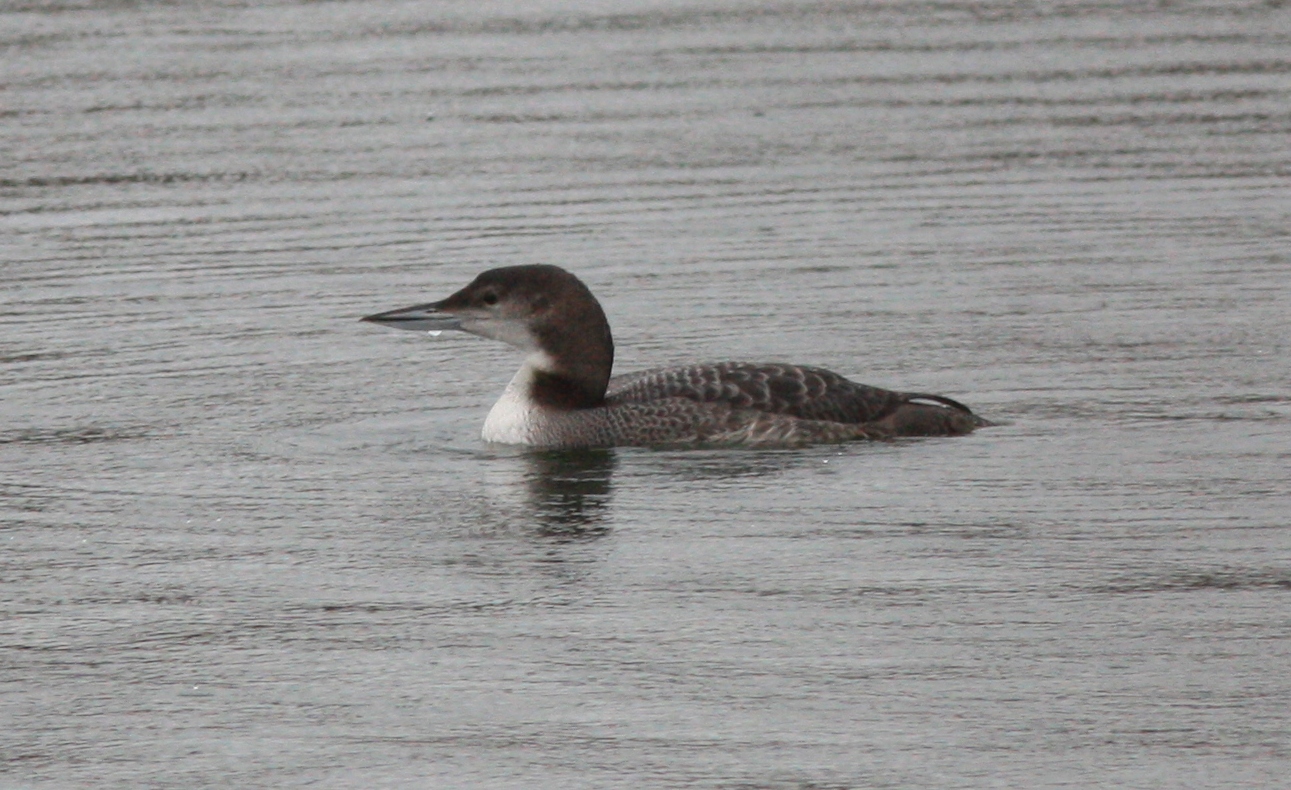
On leaving the pub (it was a coffee and a hot chocolate, ok), it was still persistently precipitating. However, we immediately spotted a large bird, fairly close to the shore on the northern half of the lake. Having just dried off and packed away our bins and cameras, there then followed a short hiatus whilst these were hurriedly extricated again! Our lenses were brought to bear on another temporary resident of the area, an immature Great Northern Diver, Gavia immer. As we watched, it drifted closer still, so despite the poor light and the rain, we were able to have a fantastic view of this Winter visitor, preening, stretching and diving.


After about 10 minutes, it decided that the show was over, and swam further out into the lake. As we walked back below the pub, a Kingfisher, Alcedo atthis, flashed passed in a blur of azure lightning, to further raise our happiness quotient.

Then, squelching back to the car, we spotted a small flock of Reed Bunting, Emberiza schoeniclus, and a pair of Bullfinches, Pyrrhula pyrrhula, to complete an excellent morning's birding.

Thanks, Keith, your blog site is fantastic, be it the virtual or the actual one!

Thursday, 29 December 2011

Wallet and grimace

My one, totally free, no commitments, do-anything-you-want-to-do day of the festive period was shared with The Admiral and JD, on a jaunt to the north Norfolk coast.

Our breakfast stop produced an anxious moment for JD, as his wallet was missing (not THAT old story!). A quick phone call back to Our Lass at Tense Towers, confirmed that it was comparatively safe, as long as she didn't embark on some opportunistic retail therapy.

After watching a gorgeous sun rise during the journey, we arrived at RSPB Snettisham just as it started to rain. I kept my camera in its bag to keep it dry, which was rather unfortunate, as the first water body we encountered contained a pristine, breeding-plumaged male Red-breasted Merganser, Mergus serrator.

By the time we climbed up onto the sea wall, to look out across The Wash and into the teeth of a gusting wind, we were cold and damp. High tide had peaked about an hour before our arrival, so our eyes beheld an ever-increasing landscape of mud. This was filled with an abundance of waders (USA - shorebirds) and ducks, though none were particularly close. The buffeting wind made binocular use a very haphazard pastime, so I sheepishly relied on the running commentary from JD and The Admiral as to the identity of the assembled birdage.

For a bit of respite from the weather, we decamped to a hide behind the sea wall, which looked across a series of freshwater ponds. Here we watched several male Goldeneye, Bucephala clangula, displaying to impress the girls and ward off the competition.

This head flinging action is accompanied by an excellent comedy duck noise!
Back out on the sea wall, during a sunny spell, an unseen raptor spooked the flocks of waders into taking to the air. Though I was using Very Wrong Len and could not capture the fluid nature of the aerial flocks, the image below conveys something of the numbers involved.

Golden Plover, Lapwing and Grey Plover, to name but a few
On the mud flats, a few braver birds were even within range of my ID skills. Here's a Grey Plover, Pluvialis squatarola, (USA - Black-bellied Plover).


Returning to the car, we then proceeded to take the scenic route to RSPB Titchwell Marsh. By the time we parked there, we were very hungry, but JD had matters under control. The Admiral and I were handed container after container of fillings for our wraps: grated cheese, home made salsa, rocket salad, chopped green peppers, chopped onions, home made houmous. And very tasty it was, too.

As we walked across the marshes (fresh, brackish, salt water), the light was pretty good, though the strong wind was chillier than ever. A Little Egret, Egretta garzetta was fishing close by the pathway, which allowed us an opportunity for a photo or two.


Down on the beach, at the water's edge, a veritable throng of waders and gulls were making the most of the last hour of daylight. Curlew, Bar-tailed Godwit, Redshank, Oystercatcher, Turnstone, Dunlin and Sanderling were all feeding together, in a thin band of feathered foraging that stretched as far as the eye could see.

Bar-tailed Godwit, Limosa lapponica
On the return journey, the sky was clear, affording good views of Venus and Jupiter, as well as an unexpected pass by the International Space Station.

Christmas, snow and bunting

For our Christmas Day fresh air, we ventured to Tring reservoirs as none of the team were keen on a muddy walk. Alongside the Grand Union canal and around several water bodies of the reservoir complex, there are firm paths offering risk-free ambling (provided that you don't fall in, obviously).

As it was a blustery day and the light, under a sullen sky, was far from optimal, I didn't take my camera. This virtually guaranteed a photo opportunity and, sure enough, not five minutes into the walk, one presented itself.

Traversing the dam head of Startops reservoir, we paused by a pair of birders who were armed to the eyeballs with optics. Just below them, where the reduced water level had left a broad margin of stony shore, was a small bird, foraging amongst the rocks and pebbles.

As Christmas gifts go, this was a beauty. My very first Snow Bunting, Plectrophenax nivalis.

Unbelievably, The Admiral was travelling light too, though he did have the presence of mind to bring a small camera. The image below is courtesy of his good self.


Saturday, 24 December 2011

Early morning Eve

And so the festive break begins.

The Admiral and I had to postpone a visit to Hanson Environmental Study Centre yesterday afternoon, due to a plumbing emergency, so we thought we'd make up for it this morning.

We arrived on site before sunrise, spooking a Buzzard from a fence post on the entrance road. Down in the river valley, a few frost pockets educated me as to why I felt so cold. Walking up the main track, we spotted a fresh paw print in some mud, a wide print with 5 toes. Badger!

We headed for the Far Hide and watched the sunrise in the company of dozens of Mute Swans, loads of Wigeon, Tufted Duck, Gadwall, Shoveler, Mallard and about 60 Lapwing. Yes, it was a crowded hide this morning!


As we made our way back through the reserve, we stopped on a boardwalk to look at the work carried out by the local RSPB Phoenix group. They had been busy removing trees from the edges of various ponds, opening up the vistas and reducing the likelihood of vegetative succession. A sudden movement close by our sides turned out to be a Robin, brazenly sat on a fence rail alongside us. It was a shame that we had not brought any bird food, as it can only have been hunger that made it so brave.

From the Near Hide, we watched as a flock of 20 Golden Plover made repeated passes over the bund, their mournful 'pew' calls reaching our ears across the water. The sun reflected beautifully from their burnished backs, a sight to warm our hearts on a cold morning. The Admiral mused that the recent work to remove scrub from the bund appeared to be paying dividends, as the more open aspect was now proving of interest to passing waders.

On leaving the hide, a Muntjac Deer was browsing along the edge of one of the cleared ponds. The Robin appeared again and I wondered if someone has been feeding it, as it did seem amazingly tame. We made a mental note to bring mealworms on our next visit.

Merry Christmas, dear reader, and best wishes from all the Tense Towers Team.

Thursday, 22 December 2011

Guess what landed on the doorstep today

Whilst I wouldn't wish to tempt fate, this year our pre-Christmas build up has been fairly straight forward for a change.

Neither my bank nor credit card company have seen fit to withdraw their facilities on the merest whim of perceived fraudulent activity.

Have I spoken too soon?

I received an email at work today informing me that a parcel had arrived at our home address. Second Born was most perplexed. It was large and flat and coarse. 

It could've been the result of a spectacular mix up at the computer ancillaries factory.

Let's face it, it's a busy time of year and the workforce was probably stressed to the max, attempting to fulfil orders before the festive season.

A small error of judgement could easily have been made when selecting the linear units for the product.

It's possible that an accidental slip of the cursor may have occurred when selecting "material type" from the drop down menu.

But no, this isn't a large, hairy mousemat.

It's the new doormat for...


Sunday, 18 December 2011

What else would you do on a lazy Sunday morning?

The thing I like about this time of year, is that you can lay in bed until nearly 8.30 and still say that you were out of bed just after dawn.

There was a heavy frost overnight, which meant that our wildlife camera had a layer of ice on it this morning. I'd set it to monitor the base of the bird feeder, in case there were any mice or voles about during the hours of darkness, but no luck, I'm afraid.

We decided to have a walk before breakfast, a rare treat these days, so we set off around Linford Manor Park, accompanied by the sounds of peeling church bells and a Mistle Thrush. There were a few flurries of snow, but little in the way of a breeze, so it did not feel bitingly cold.

Through the village, the hedges along the path were laden with Ivy berries, some of which were just starting to ripen. In cultivated areas, the yellow flowers of Mahonia bushes and the delicately-scented pale blooms of Winter-flowering Honeysuckle were bringing some cheer to the dormant plots.

As we made our way back to the Grand Union canal for the last leg of the journey, we discovered where all the bird life had got to. Walking along the towpath, we spotted a Fieldfare, a Redwing, a Bullfinch and a flock of Long-tailed Tits, all feeding on the trees lining the opposite bank of the canal. At Linford Wharf, there was a pair of Pied Wagtails, pottering about on the ice of the frozen turning basin.

Crunching through the frosty gravel, we returned home to find a pair of Jackdaws on the roof of Tense Towers. They were busy dislodging lumps of moss from the tiles, as they searched for food. It's difficult to begrudge them this task, but it does take me ages to pick it all up from where it falls, on the garden path and the roof of Our Lass's car. Still, we can truthfully add them to our list of garden birds using the environs of Tense Towers this Winter.