Badgers. Cattle. TB.
It's a thorny problem, with farmers ending up financially crippled on the one hand, whilst at the other end of the spectrum, badgers end up dead.
I've pretty much stayed out of the badger culling debate, other than signing the petition against what is, after all, another ploy to legally slaughter more of the nation's wildlife, because I appreciate that farmers have to make a living. And if you want a breakfast consisting of cereals, milk, bacon, eggs, sausages and toast, then you're going to need a farmer at some point.
However, as a profession, I think they have been hoodwinked by some dodgy interpretations of scientific statistics and have jumped to a few ill-judged conclusions of dubious benefit to anyone. Least of all a badger.
I have let these thoughts fester away in the back of my mind for months, whilst the debate has rumbled on between Government, its scientists, the farmers' lobby and conservation bodies.
The official position: DEFRA
The case for the prosecution: NFU
The case for the defence: The Badger Trust, Badgerland
Two weeks ago, however, I reached a tipping point and, today, the glacial slowness of my thoughts finally reached a keyboard as the second licence to cull badgers was issued by Natural England.
What happened two weeks ago? You may well ask. But first, some background.
In the 1930s, here in the UK, there was a huge problem with bovine TB. An epidemic spiralling out of control, that was only halted by cattle-based controls. Towards the end of the 20th Century, the infection began to increase again. Coincidentally, the first badger known to have bovine TB was discovered in 1971, and this brought the animal into the steely glare of the farming community at a critical time. The increase couldn't possibly have anything to do with a relaxation of cattle testing and movements, nor an intensification of the practice of over-wintering huge herds in barns and sheds? Where the bacterium could easily spread? Hell, no.
Up until the time that milk was routinely pasteurised, humans could contract TB from cattle. These days, in the UK, this is now a very rare occurrence because of pasteurisation. There are strict controls in place to deal with milk and meat from infected cattle.
Which brings me back to my tipping point.
Broadcaster and food writer Clarissa Dickson Wright reckons that we should eat badgers, so that the culled animals aren't wasted. O...kay, it's quite a thrifty argument, waste not, want not, and all that. They probably taste quite nutty, since every wildlife presenter worth their salt is out there, night after night, with a bag of peanuts to tempt the badgers to put in an appearance for the cameras. We should probably put an allergy warning label on them.
But hang on a minute, we're killing the badgers because they're judged to spread TB.
If we can eat a badger with TB, why the f**k can't we eat a cow with TB and not shoot the bloody badgers?
Thursday, 4 October 2012

Sunday, 30 September 2012
September in Little Linford Wood
September nearly passed me by. On the antepenultimate day of the month, I realised that I only had the weekend left to visit the site before it was October. So that was the schedule for Saturday morning sorted.
Following a week of intermittent heavy rain and strong winds, I was expecting to be greeted by a soggy scene of mud and flattened vegetation, but on a bright, though breezy, morning nothing could be further from the truth.
During the intervening weeks since my last visit, the picnic area and woodland rides have been mown to allow better access. Happily, the paths had not turned to sticky goo, but they were covered in a scattering of broken branches and twigs that did hint at the force of the week's winds.

The car park pond still had very little water in it, so perhaps the rain had bypassed Little Linford Wood altogether. I found a female Migrant Hawker dragonfly roosting on a tree in the glade immediately to the south of where this photo was taken. But she was the only ode we saw at this point.
Whilst Buzzards called overhead and Jays raided the many Oak trees for their acorns, the buffeting breeze made it difficult to find insect life. However, in the occasional calm and warm spot, we spotted several species of butterfly, Red Admiral, Comma, Speckled Wood and Large White. We disturbed a few Common Darter dragonflies, who flew up from their perches on the path, where they were making the most of the heating qualities of clumps of dried grass.
The most obvious feature of the wood this month was the quantity of berries on display. Whilst all the Elderberries had either been consumed by the wildlife or fallen to the ground, other bushes and shrubs were teeming with fruit.
We did find a large Spindle tree, but as it was so tall, its pink fruit with their eye-wateringly colour-clashing orange seeds were out of reach of my camera phone.
Through the hedges that line the perimeter of the wood were twined another prolific fruiter, Black Bryony.
My copy of Wild Flowers of Britain and Ireland, by Blamey, Fitter and Fitter, informs me that it can be distinguished from the similarly-named but totally unrelated White Bryony, by the fact that it twines clockwise. And the leaves are completely different, Black having broad heart-shaped ones and White having palmately-lobed ones, but that's not so juicy a fact, eh?
On our amble around the wood, we did find one stretch of gloriously sheltered, sun-drenched hedgerow and it was full of insect life. We first noticed many more Common Darters, then Red Admiral and Comma butterflies competing for nectar, before spotting another Migrant Hawker and an abundance of small flies. However, the most striking feature of this warm oasis was a constant stream of Hornets, flying back and forth along the hedge, intent upon their waspish preying of smaller insects. Their time is now short, for soon only the young mated queens will be left, looking to find a safe place to hibernate before Winter arrives. But it was amazing, if a little nerve-wracking, to stand and watch for a while as if on a central reservation, while the motorway of yellowness zoomed passed in each direction, every vehicle concentrating on going from A to bee.
Following a week of intermittent heavy rain and strong winds, I was expecting to be greeted by a soggy scene of mud and flattened vegetation, but on a bright, though breezy, morning nothing could be further from the truth.
During the intervening weeks since my last visit, the picnic area and woodland rides have been mown to allow better access. Happily, the paths had not turned to sticky goo, but they were covered in a scattering of broken branches and twigs that did hint at the force of the week's winds.

The car park pond still had very little water in it, so perhaps the rain had bypassed Little Linford Wood altogether. I found a female Migrant Hawker dragonfly roosting on a tree in the glade immediately to the south of where this photo was taken. But she was the only ode we saw at this point.
Whilst Buzzards called overhead and Jays raided the many Oak trees for their acorns, the buffeting breeze made it difficult to find insect life. However, in the occasional calm and warm spot, we spotted several species of butterfly, Red Admiral, Comma, Speckled Wood and Large White. We disturbed a few Common Darter dragonflies, who flew up from their perches on the path, where they were making the most of the heating qualities of clumps of dried grass.
The most obvious feature of the wood this month was the quantity of berries on display. Whilst all the Elderberries had either been consumed by the wildlife or fallen to the ground, other bushes and shrubs were teeming with fruit.
 |
| Dogwood, Cornus sanguinea |
 |
| Hawthorn, Crategus monogyna |
 |
| Dog rose, Rosa canina |
 |
| Guelder-rose, Viburnum opulus |
 |
| Bramble, Rubus fruticosus |
 |
| Blackthorn, Prunus spinosa |
Through the hedges that line the perimeter of the wood were twined another prolific fruiter, Black Bryony.
 |
| Black Bryony, Tamus communis |
On our amble around the wood, we did find one stretch of gloriously sheltered, sun-drenched hedgerow and it was full of insect life. We first noticed many more Common Darters, then Red Admiral and Comma butterflies competing for nectar, before spotting another Migrant Hawker and an abundance of small flies. However, the most striking feature of this warm oasis was a constant stream of Hornets, flying back and forth along the hedge, intent upon their waspish preying of smaller insects. Their time is now short, for soon only the young mated queens will be left, looking to find a safe place to hibernate before Winter arrives. But it was amazing, if a little nerve-wracking, to stand and watch for a while as if on a central reservation, while the motorway of yellowness zoomed passed in each direction, every vehicle concentrating on going from A to bee.
Monday, 24 September 2012
Naval top brass in drunken spree with goat...
Don't you just loathe sensationalist tabloid headlines? Those that twist the merest thread of truth into a preposterous yarn of such outrageous colours that your eyes hurt? Vastly exaggerated tales that promise much and deliver less than nothing? Hmmm, I know what you mean.
But it ain't gonna get in the way of a story...
Early in the month, and in the company of JD, Our Lass and I ventured over to RSPB Lakenheath Fen for a wildlifey day midst the wetland habitat beside the River Little Ouse. It was a gloriously warm day with plenty of sunshine that guaranteed some dragonfly activity, if not much in the way of ornithological interest. But more of that in due course.
However, the most fascinating part of the day was completely off the wall, off the radar, and very left field, as the sayings go. In fact, to be exact, it was very left carrot field, this being the reserve's former life before habitat recreation was begun.
After walking around a footpath loop in the north east corner of the site, we were returning to the car for a much-anticipated picnic, when a movement at the base of a tree caught my eye. To be honest, I wasn't sure that I had seen anything concrete, it was more likely a shadow from a branch moving in the breeze. But the old Nature neurones were firing like crazy, so I stopped to have a second look. I mentioned to JD that something small and dark had flown from the base of a Birch tree and disappeared behind a nearby Pine tree. Probably too small to be a bird, but what else would fly out from the shade, low down a tree trunk?
Skirting around the Pine, we found a Red Admiral butterfly roosting in the sun. OK, that answered the 'what', but not the 'why'. Looking around the adjacent Gorse bushes, there were several more butterflies, mostly Red Admirals, lazily having a bit of a siesta in the heat of the day. This was actually a big clue, if only we'd thought about it in those terms!
As we photographed the butterflies, it became apparent that more were arriving all the time. And all from downwind. What the heck was pulling them in? Then we noticed that the Gorse bushes weren't the centre of attraction, that honour went to the base of the Birch tree. Good old Nature neurones, they'd been right all along.

The lower part of the trunk was surrounded by chicken wire (as were most of the Birches in the area) but whether this was significant we couldn't be certain. However, there was no doubting that there were several holes in the tree, though they seemed too low down to be caused by a Woodpecker. Despite the wire, several Red Admiral butterflies were gathered in the crevices of the gnarled and holed bark, so we assumed that Birch sap was oozing out and the insects were drinking this. However this did not offer sufficient explanation for the holes in the trunk.
Recourse to that hit-and-miss solver of mysteries, the internet, revealed that this was a phenomenon with a fairly rational, if a little bizarre, explanation.
The larvae of the Goat Moth feed and grow inside tree trunks. Due to the poor nutritional value of the wood, it can take up to 5 years for the larvae to become fully grown and exit the tree to pupate. Along with their bodily output, the larvae create runs of fermented sap on the exterior of the trunk and many insects will seek this out to feed upon.
In this instance, this had resulted in not only plenty of 'happy' Red Admirals, but also three happy naturalists.
We had not seen this particular interaction between species before, indeed we had not known of its existence. I was so amazed that when, later in the day, a Hobby flew passed with a dragonfly in its talons, I didn't even mind that much.
But it ain't gonna get in the way of a story...
Early in the month, and in the company of JD, Our Lass and I ventured over to RSPB Lakenheath Fen for a wildlifey day midst the wetland habitat beside the River Little Ouse. It was a gloriously warm day with plenty of sunshine that guaranteed some dragonfly activity, if not much in the way of ornithological interest. But more of that in due course.
However, the most fascinating part of the day was completely off the wall, off the radar, and very left field, as the sayings go. In fact, to be exact, it was very left carrot field, this being the reserve's former life before habitat recreation was begun.
After walking around a footpath loop in the north east corner of the site, we were returning to the car for a much-anticipated picnic, when a movement at the base of a tree caught my eye. To be honest, I wasn't sure that I had seen anything concrete, it was more likely a shadow from a branch moving in the breeze. But the old Nature neurones were firing like crazy, so I stopped to have a second look. I mentioned to JD that something small and dark had flown from the base of a Birch tree and disappeared behind a nearby Pine tree. Probably too small to be a bird, but what else would fly out from the shade, low down a tree trunk?
 |
| Exhibit A: a Birch tree |
As we photographed the butterflies, it became apparent that more were arriving all the time. And all from downwind. What the heck was pulling them in? Then we noticed that the Gorse bushes weren't the centre of attraction, that honour went to the base of the Birch tree. Good old Nature neurones, they'd been right all along.

The lower part of the trunk was surrounded by chicken wire (as were most of the Birches in the area) but whether this was significant we couldn't be certain. However, there was no doubting that there were several holes in the tree, though they seemed too low down to be caused by a Woodpecker. Despite the wire, several Red Admiral butterflies were gathered in the crevices of the gnarled and holed bark, so we assumed that Birch sap was oozing out and the insects were drinking this. However this did not offer sufficient explanation for the holes in the trunk.
 |
| There's at least 3 butterflies here |
The larvae of the Goat Moth feed and grow inside tree trunks. Due to the poor nutritional value of the wood, it can take up to 5 years for the larvae to become fully grown and exit the tree to pupate. Along with their bodily output, the larvae create runs of fermented sap on the exterior of the trunk and many insects will seek this out to feed upon.
In this instance, this had resulted in not only plenty of 'happy' Red Admirals, but also three happy naturalists.
 |
| Lepidopteran contentment |
 |
| No-o-o-o-o-o! |
Monday, 17 September 2012
Swale watching - Gunnerside Gill
This post from our holiday in Swaledale was so very nearly entitled 'Bwah hah hah! Mine, all mine!', for reasons that may shortly become obvious.
For our final full day in the idyllic dale of the River Swale, Our Lass wanted to hike up to Gunnerside Gill. This is most easily accessed from the village of Gunnerside, gently climbing the valley of the eponymous Beck until the green pastures and the woods are left behind and the vista becomes at once bleaker and more industrial.
This is an industry that has long gone, yet its ruins and previous activity still scar the landscape with the ruggedly fiercesome beauty of recent archaeology.
As with much of the Pennine range of hills, very little of the landscape is not touched by human hand. For instance, the dale where I grew up in County Durham has been mined for various metals over the centuries, principally lead, iron, silver and aluminium. And that's without mentioning any quarrying for other minerals. All this activity leaves behind spoil heaps, redundant buildings and an all-consuming feeling that the land has been comprehensively worked.
Returning to North Yorkshire, Gunnerside Gill was at the centre of a lead mining boom from the 17th to the 19th Century. As we slowly ascended the eastern side of the valley, old mining structures and features came into view, until we found ourselves in a landscape that felt wild, indeed was wild, but was also the aftermath of a vast industrial process. Time has softened some of the edges, Nature has reclaimed the hills to a degree, but there's no doubt 'who woz 'ere'.
The above photo shows two different methods of accessing the ore-bearing rock at Bunton Mine. The old entrance, or adit, is the only visible sign on the surface of a level driven into the hillside to reach deeper veins of galena. The deep gash in the hillside is a hush, the result of water being dammed above the lead seam and released in a rush. The overlying debris would be washed away, exposing the ore-bearing rock, which could then be extracted at the surface with picks and chisels.
Across the valley from the Bunton Level, could be seen another hush leaving a deep scar on the landscape. To the left of it, a disused building and spoil heaps of unwanted tippings.

Some of the structures are now listed buildings, important in their own right as industrial archaeology. Here a mine entrance, complete with a hopper and narrow gauge railway have been conserved.

Further up the valley, where Blind Gill joins the main beck, lie the ruins of the Blakethwaite smelt mill and peat store. The peat store is in the foreground, looking for all the world like some mediaeval religious building (and I suppose if money was your God, then yes it is). The smelt mill lies behind it, and above that, the course of the flue can be just made out, running up the hillside to a long-since demolished chimney.

Here's another view of the ruin of the smelt mill and peat store, this time looking down the Gill. We ate our picnic here, by the confluence of two streams, in awe of the scale of this ancient endeavour and shocked by the lasting legacy it has left behind and the pollution it must have caused back then. The gurgling and splashing of the becks reminded us that Nature will out, and to prove it, a dragonfly appeared, caught a smaller insect and then landed beside us to consume its meal.
We retraced our steps so far down the valley and then forded the beck to climb the opposite hillside on our route back to Gunnerside. A Merlin shot past us, intent on catching a Meadow Pipit, whilst a couple of Red Grouse crouched warily amongst the Heather, as distant guns signalled another game shoot. These things, too, are part of the timeless tapestry of dales life, a world away from traffic jams, mobile phones and satellite dishes.
That night, our wedding anniversary, we shared the evening meal with the other guests at Rowleth End, one couple from the North East (she, a horsewoman, and he, a huntsman) and another couple from the West Riding of Yorkshire (she, a hospital pharmacist, and he, something in consumer electronics). It was interesting listening to other people's viewpoints and discussing our shared reasons for our journeys to Swaledale. Making conversation does not come easily to one as grumpy as myself. It's definitely more difficult than IDing dragons. However, the food and the wine worked their magic and folk were even gracious enough to laugh at my occasional jokes.
I cannot leave this post without thanking Roger and his staff for a wonderful holiday. The subtle blend of Art Deco surroundings and the welcoming informality of all at Rowleth End were the perfect antidote to the daily grind of 21st Century living. The fires may be extinguished in the smelt mills of long ago, but during the week, something was rekindled in our spirits and the flame burns afresh once more.
For our final full day in the idyllic dale of the River Swale, Our Lass wanted to hike up to Gunnerside Gill. This is most easily accessed from the village of Gunnerside, gently climbing the valley of the eponymous Beck until the green pastures and the woods are left behind and the vista becomes at once bleaker and more industrial.
This is an industry that has long gone, yet its ruins and previous activity still scar the landscape with the ruggedly fiercesome beauty of recent archaeology.
As with much of the Pennine range of hills, very little of the landscape is not touched by human hand. For instance, the dale where I grew up in County Durham has been mined for various metals over the centuries, principally lead, iron, silver and aluminium. And that's without mentioning any quarrying for other minerals. All this activity leaves behind spoil heaps, redundant buildings and an all-consuming feeling that the land has been comprehensively worked.
Returning to North Yorkshire, Gunnerside Gill was at the centre of a lead mining boom from the 17th to the 19th Century. As we slowly ascended the eastern side of the valley, old mining structures and features came into view, until we found ourselves in a landscape that felt wild, indeed was wild, but was also the aftermath of a vast industrial process. Time has softened some of the edges, Nature has reclaimed the hills to a degree, but there's no doubt 'who woz 'ere'.
 |
| Bunton Level and Hush |
 |
| North Hush and Lownathwaite Lead Mine |

Some of the structures are now listed buildings, important in their own right as industrial archaeology. Here a mine entrance, complete with a hopper and narrow gauge railway have been conserved.

Further up the valley, where Blind Gill joins the main beck, lie the ruins of the Blakethwaite smelt mill and peat store. The peat store is in the foreground, looking for all the world like some mediaeval religious building (and I suppose if money was your God, then yes it is). The smelt mill lies behind it, and above that, the course of the flue can be just made out, running up the hillside to a long-since demolished chimney.

Here's another view of the ruin of the smelt mill and peat store, this time looking down the Gill. We ate our picnic here, by the confluence of two streams, in awe of the scale of this ancient endeavour and shocked by the lasting legacy it has left behind and the pollution it must have caused back then. The gurgling and splashing of the becks reminded us that Nature will out, and to prove it, a dragonfly appeared, caught a smaller insect and then landed beside us to consume its meal.
 |
| Common Hawker and lunch |
That night, our wedding anniversary, we shared the evening meal with the other guests at Rowleth End, one couple from the North East (she, a horsewoman, and he, a huntsman) and another couple from the West Riding of Yorkshire (she, a hospital pharmacist, and he, something in consumer electronics). It was interesting listening to other people's viewpoints and discussing our shared reasons for our journeys to Swaledale. Making conversation does not come easily to one as grumpy as myself. It's definitely more difficult than IDing dragons. However, the food and the wine worked their magic and folk were even gracious enough to laugh at my occasional jokes.
I cannot leave this post without thanking Roger and his staff for a wonderful holiday. The subtle blend of Art Deco surroundings and the welcoming informality of all at Rowleth End were the perfect antidote to the daily grind of 21st Century living. The fires may be extinguished in the smelt mills of long ago, but during the week, something was rekindled in our spirits and the flame burns afresh once more.
Sunday, 16 September 2012
Field notes 7
To be honest, I thought I'd finished the series of posts about our wildflower border. Seems I forgot to ask the plants...
As you sow so shall you reap.
The wet summer had prolonged the blooms of the floral experiment at the front of Tense Towers. Now, however, the season is drawing to a close, the petals have mostly gone, to be replaced by drying seed heads and garden spiders in their silken webs. As the stems lose their green hue and turn that tired straw colour, I am tempted to cut down the whole border.
But, I say "mostly", because the Cornflowers are still going strong, showing no inclination to give in to Autumnal urges and they are still providing a food supply for countless bees. The colours are still as vivid, so I don't feel like I can pick up the shears just yet.
It did occur to me this week, as I stood gazing at the jumble of brown stems and incongruous blue flowers, that here was a seed bank ready for the taking. Daft though it may seem, I hadn't even considered the end point of the experiment at all, the Summer colour had been my only goal. Yet given the possibility that the seed was viable, here was an opportunity for floral immortality.
To recap, seven of the nine species of seed sown had germinated. Only the Buttercup and Catchfly failed to put in an appearance, probably due to my lateness in committing the seed to the earth. The Field Forget-me-not was swamped by the other six species, and in the Summer, I smiled wryly when I realised that this particular flower was growing in our garden anyway.
The most obvious seed heads, and the largest seed to boot, belonged to the Corn Cockle, so I began the harvest with these. Snipping off the heads as I worked my way along the border, I soon had a small basketful. Later, sat in the evening sun, I cracked open each head and flicked out the hard black seeds. I found a few Earwigs too, which made me jump, and I don't suppose the Earwigs were particularly happy either! I was left with a container of predominantly Corn Cockle seed with an amount of dried petal and sepal amongst it. By carefully shaking the container, then tipping it to one side and gently blowing across the top, I found that I was able to winnow away the unwanted material.
Result!
The same technique worked for the Corn Chamomile, Thorow-wax and Corn Marigold, though there were fewer seed heads of these.
I was now looking forward to the Poppies, with their pepperpot heads. By cutting off a few inches of dried stem with the head, I found that I could twirl the pepperpot around, flinging out the tiny black dots of Poppy seed into a lightweight plastic tray. This also had the added bonus of making a satisfying rattling sound. In hindsight, setting the tray down on the lawn, whilst I wandered off to the other end of the border to cut more heads, wasn't a great move. A gust of wind meant that the tray soon joined me, without its contents, and I had to start the Poppy process all over again. Next year, I predict a riot of colour in a small patch of lawn.
That just left the Cornflowers.
Though they were still in bloom, they had also been the first of the crop into flower, so where were all the seed heads? The growth from the whole border had fallen forward across the path that runs alongside the lawn, and by lifting up this mass of dying herbage, I discovered a veritable carpet of seeds, mostly Cornflower. I wasn't going to need the secateurs for this part of the task, so opted for the trusty dustpan and brush technique.
Emptying the sweepings into a large tray, I began to remove the obvious pieces of dried detritus that had also been collected: small stones, lumps of earth, abandoned snail shells, a cigarette butt dropped by the window cleaner, empty seed heads and sundry bits of vegetation. It will probably take me all Winter to sort through the harvestings. Indeed, Our Lass suggested that I simply plough the lot back into the border, but my concern is that it will lead to a too Cornflower-centric display, so my task continues.
Wake me up when it's Spring, please.

Friday, 14 September 2012
Yet more Swale watching
The Monday of our stay in Swaledale was wetter than Wetty, the wet thing.
On bath night.
We drove across to Lancashire to visit the RSPB reserve at Leighton Moss. I had called in here the previous month when returning from Scotland, so thought a more leisurely visit would fill a damp day, skittering from cafe to hide to cafe to hide to cafe. And so we did.
We didn't see much in the way of spectacular birdage, but our waterproofs had a fantastic time, thanks.
The drive back was fairly special. Having had a whole day to practise raining, the clouds had really got the hang of it by evening, and were keen to impress. As we toured across the top of Ribblesdale and over to Wensleydale, the amount of water pouring off the hills was phenomenal. By the time we dropped down into Hawes, the River Ure was close to bursting its banks. Oddly, the water levels just over the next hill and into Swaledale were very modest, so there was no flooding on our doorstep.
We were glad of this the next morning as we wandered down to the Swale, for another attempt at finding Dippers. The sun was out, the air was fresh and Life felt gre... Wow! Look! Dippers!


Out in mid-stream, two Dippers were seemingly interacting with each other. Whether they were a breeding pair, I don't know, but other Dippers we saw were probably juvenile, their plumage not as well-defined.


They are dapper chaps, bobbing about (hence the name) and plunging into the flow to look for invertebrates amongst the pebbles on the river bottom.
There were some Pied Wagtails around too. This one could well have been a juvenile, with its much greyer plumage.

The plan for the day was a leisurely walk from the village of Muker, along the north bank of the Swale, crossing the river just below Keld and a return trip through the fields along the south bank.
We parked in Muker and bought sandwiches for lunch at the local shop. Whilst Our Lass paid a visit to the public convenience built beside the river, I idly scanned the vegetation on the bank, in the vain hope of spotting a dragon roosting in a patch of sun. Not a chance. However, a Kingfisher did put in a brief appearance, the only one I saw all week. It was a bit of a shame Our Lass missed it!
We set off through the small fields on the valley floor. Each one populated by its own stone barn.

Known locally as 'laithes', these late 18th or early 19th Century buildings housed cattle and the hay to feed them during the Winter. The muck collected inside was spread on the surrounding meadows in the Spring to nourish the next hay crop.
The field boundaries were all dry stone walls, and where the path crossed one, there would be an incredibly narrow gap to squeeze through. At least, we found them incredibly narrow!
Soon we were walking beside the River Swale, and living up to her billing as the ultimate wildlife good luck totem, Our Lass spotted our first dragon of the trip (it was four days into the holiday and I was having withdrawal symptoms). We watched it for several minutes, as it foraged over the vegetation, before it landed on a rock to bask and allowed us a closer look. A female Common Hawker, with narrow, reduced antehumeral stripes on top of the thorax and a yellow costa (leading edge) to each wing.

As Summer cools towards Autumn, each consecutive dragon sighting becomes that bit more special to me, knowing that their time is short and soon the year will be bereft of their vivid colours, the clatter of delicate wings and their hypnotic aerial mastery.
Sigh.
After a few miles, we found a sunny spot for lunch, on a slight rise as the path climbed the hillside. We could gaze right and left, up and down stream and across the valley to the hill known as Kisdon.
Several hours later, we ambled, much more slowly, through the fields in the middle distance in the above photo. We met a couple walking in the opposite direction, who, noticing Very Wrong Len, asked what he was used for...
"Birds?"
"Dragons," quoth I, "but we've only seen one all day."
They then commented how they had seen one earlier too, and described the exact location where we had seen Mrs Common Hawker that morning.
She was obviously Upper Swaledale's most popular insect that day!
We finally made it back to Muker, where Our Lass stopped outside the Farmer's Arms pub and proclaimed that she wasn't walking another step. We struck a deal. As well as my own gear, I would carry her rucksack, walking poles and binoculars back to the car, whilst she would carry my wallet to the bar and purchase two pints of local ale. But only drink one of them before I returned, hopefully.
Cheers!
On bath night.
We drove across to Lancashire to visit the RSPB reserve at Leighton Moss. I had called in here the previous month when returning from Scotland, so thought a more leisurely visit would fill a damp day, skittering from cafe to hide to cafe to hide to cafe. And so we did.
We didn't see much in the way of spectacular birdage, but our waterproofs had a fantastic time, thanks.
The drive back was fairly special. Having had a whole day to practise raining, the clouds had really got the hang of it by evening, and were keen to impress. As we toured across the top of Ribblesdale and over to Wensleydale, the amount of water pouring off the hills was phenomenal. By the time we dropped down into Hawes, the River Ure was close to bursting its banks. Oddly, the water levels just over the next hill and into Swaledale were very modest, so there was no flooding on our doorstep.
We were glad of this the next morning as we wandered down to the Swale, for another attempt at finding Dippers. The sun was out, the air was fresh and Life felt gre... Wow! Look! Dippers!


Out in mid-stream, two Dippers were seemingly interacting with each other. Whether they were a breeding pair, I don't know, but other Dippers we saw were probably juvenile, their plumage not as well-defined.


They are dapper chaps, bobbing about (hence the name) and plunging into the flow to look for invertebrates amongst the pebbles on the river bottom.
There were some Pied Wagtails around too. This one could well have been a juvenile, with its much greyer plumage.

The plan for the day was a leisurely walk from the village of Muker, along the north bank of the Swale, crossing the river just below Keld and a return trip through the fields along the south bank.
We parked in Muker and bought sandwiches for lunch at the local shop. Whilst Our Lass paid a visit to the public convenience built beside the river, I idly scanned the vegetation on the bank, in the vain hope of spotting a dragon roosting in a patch of sun. Not a chance. However, a Kingfisher did put in a brief appearance, the only one I saw all week. It was a bit of a shame Our Lass missed it!
We set off through the small fields on the valley floor. Each one populated by its own stone barn.

Known locally as 'laithes', these late 18th or early 19th Century buildings housed cattle and the hay to feed them during the Winter. The muck collected inside was spread on the surrounding meadows in the Spring to nourish the next hay crop.
The field boundaries were all dry stone walls, and where the path crossed one, there would be an incredibly narrow gap to squeeze through. At least, we found them incredibly narrow!
Soon we were walking beside the River Swale, and living up to her billing as the ultimate wildlife good luck totem, Our Lass spotted our first dragon of the trip (it was four days into the holiday and I was having withdrawal symptoms). We watched it for several minutes, as it foraged over the vegetation, before it landed on a rock to bask and allowed us a closer look. A female Common Hawker, with narrow, reduced antehumeral stripes on top of the thorax and a yellow costa (leading edge) to each wing.
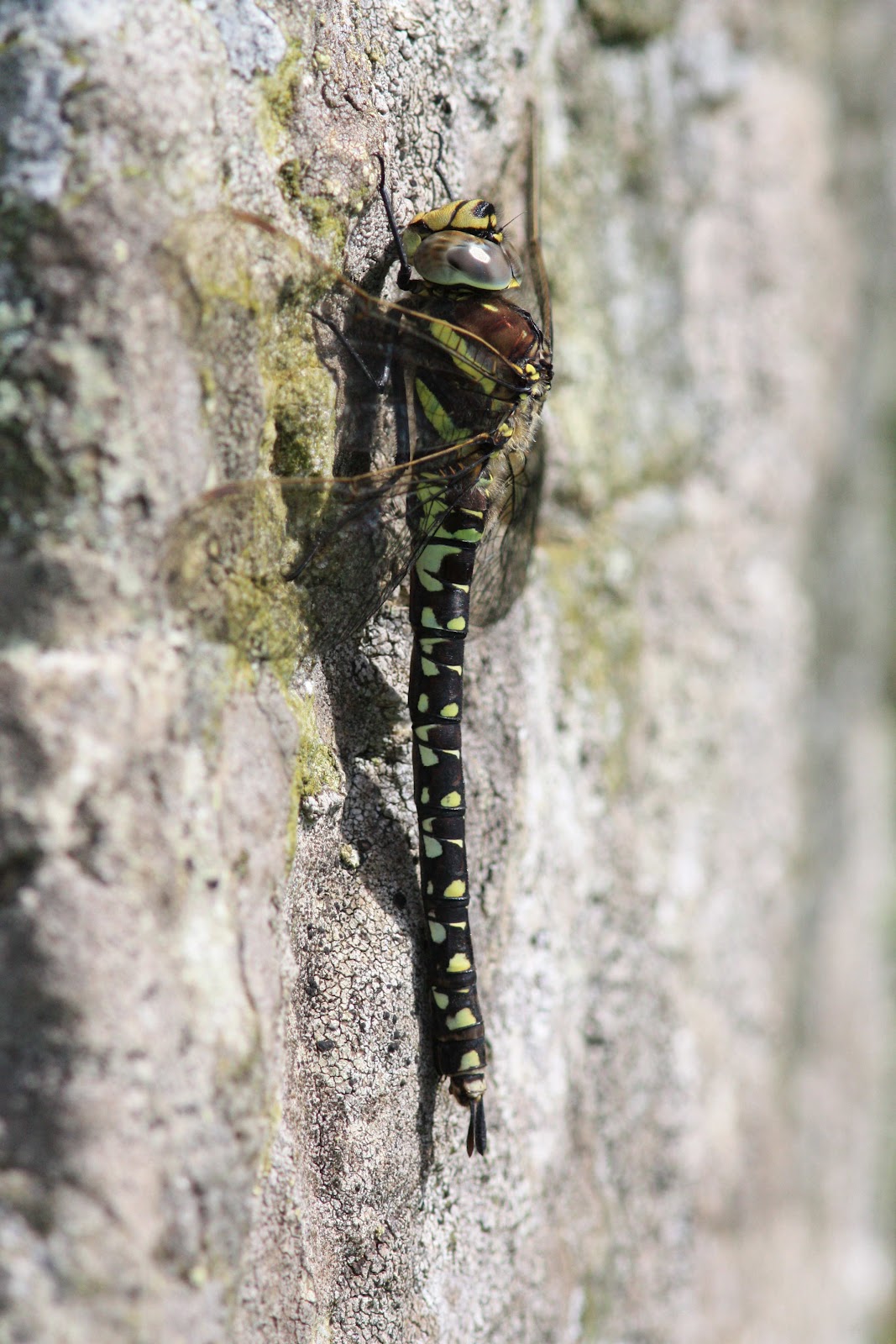
As Summer cools towards Autumn, each consecutive dragon sighting becomes that bit more special to me, knowing that their time is short and soon the year will be bereft of their vivid colours, the clatter of delicate wings and their hypnotic aerial mastery.
Sigh.
After a few miles, we found a sunny spot for lunch, on a slight rise as the path climbed the hillside. We could gaze right and left, up and down stream and across the valley to the hill known as Kisdon.
 |
| Looking downstream in upper Swaledale, the lower slopes of Kisdon on the right |
"Birds?"
"Dragons," quoth I, "but we've only seen one all day."
They then commented how they had seen one earlier too, and described the exact location where we had seen Mrs Common Hawker that morning.
She was obviously Upper Swaledale's most popular insect that day!
We finally made it back to Muker, where Our Lass stopped outside the Farmer's Arms pub and proclaimed that she wasn't walking another step. We struck a deal. As well as my own gear, I would carry her rucksack, walking poles and binoculars back to the car, whilst she would carry my wallet to the bar and purchase two pints of local ale. But only drink one of them before I returned, hopefully.
Cheers!
Wednesday, 12 September 2012
Swale watching - the director's cut
 |
| He was well aware that there was more chance of the rain stopping than a Dipper turning up. |
 |
| View across the valley floor to Whitaside Moor |
 |
| River Swale |
 |
| Smelting Mill and Peat Store at Surrender Bridge |
 |
| Heather glowing in the low evening sun |
 |
| Old Gang Beck |
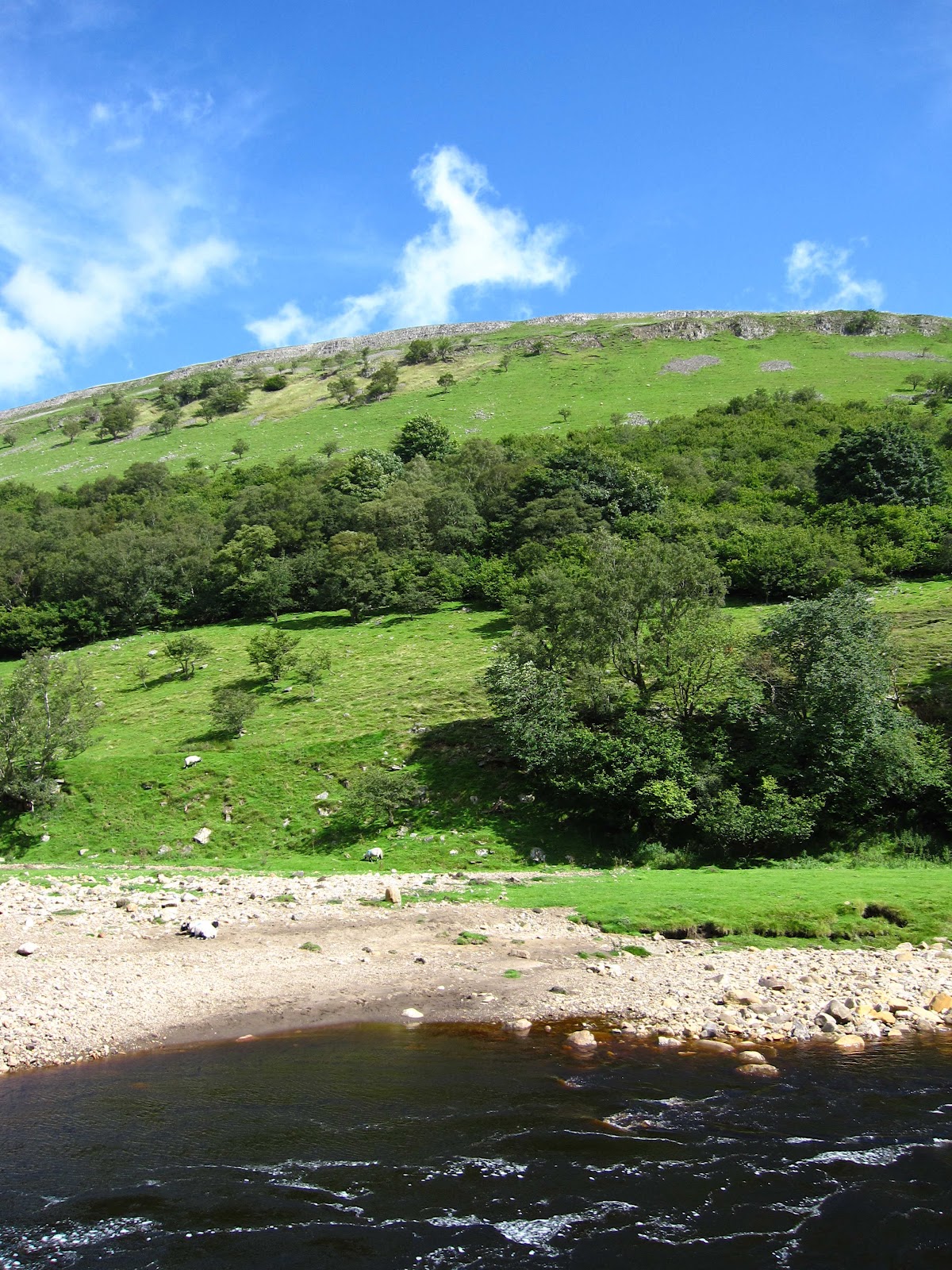 |
| By the River Swale above Muker, looking up to Ivelet Side |
All photos taken by Our Lass, 26-28/08/12
Subscribe to:
Posts (Atom)