Tuesday, 11 September 2012

More Swale watching

The following day, my brother and his wife offered to meet up with us in the Swaledale village of Reeth. But first, a quick visit to the river below Rowleth End in search of Dippers, which we subsequently dipped (i.e. didn't see them), but happily discovered that the Grey Wagtails were still around.


By mid morning, when we arrived in Reeth, the place was buzzing, so we immediately sought out some peace and quiet in the nearest tea shop (don't look surprised, here was double the usual amount of Tense genes, where else were we going to go?). Call it Brothers in Alms. Anyway, we can heartily recommend The Copper Kettle.

From the village green, we headed down into the valley and crossed over the river on a small suspension bridge. I tried in vain to photograph Sand Martins as they returned to their nests in the river bank to feed their young. I was nowhere near quick enough. We walked downstream to the village of Grinton, crossing back over the river on the road bridge, and then gradually climbing up the opposite hillside through High Fremington, ending up at Cuckoo Hill.

Following a breather, spent gazing across Reeth and on into Upper Swaledale, we pottered back through the fields alongside Arkle Beck. In the lee of one of the field barns, young Swallows and House Martins were gathered in an old tree, rather like carefree children on a huge climbing frame.


By the time we arrived back on the village green, it was twenty to three in the afternoon. All the pubs had stopped serving lunch (despite plenty of folk being in a similar situation to our ravenous selves) and it started to rain. Oh what a quandary! A veritable culinary conundrum! Where could we seek solace from the fickle Summer weather and the growing hunger pangs?

Well, there's always The Copper Kettle!

When my post meal digestory slump kicked in, we crossed the green to a pub and sat out the showers. The boys, as designated drivers, ruefully watching the girls, who weren't. Before we went our merry ways, we called into a baker's shop (yes really, at 5 in the afternoon on a Sunday, there was a baker's shop open). Provender was purchased for a light evening meal,  goodbyes and hugs were shared, then Clan Tense ceased their gathering. The Lowlanders returning to the east coast, whilst the Highlanders drove up into the hills.

I must've found the narrowest, awkwardest bit of road possible, because by the time we had navigated across the hillside (with much reversing to let cars through and the occasional gate to open) my eyes were on stalks and I was wide awake. Trembling slightly, with shallow breathing, but definitely awake.

We parked by Surrender Bridge, one of the many sites in these dales where ruinous buildings survive from the old lead mining industry. By the banks of the Old Gang Beck, on a dilapidated wall of the Smelting Mill, we discovered a female Red Grouse. Two weeks into the shooting season, she was probably as glad of the peace and quiet as we were.


Not far away, just below an old peat store, we met Mr Red Grouse scurrying across the rocks between patches of Heather.


When the low sun put in an early evening appearance, the Heather lit up like a wonderful radiant carpet of purple hues. Indeed, possibly no-one was happier than one of the local sheep, from the eponymously-named Swaledale breed.

Meh-eh-eh-eh!
I'm not totally sure it was supposed to have a Mohican hair do.

Thursday, 6 September 2012

Swale watching

During the last week of August, Our Lass and I spent seven days in Swaledale, happily ensconced in one of the plushest bird hides known to Man.

The weather, as can be expected for a British Summer, was a bit bipolar in mood, alternately dry then wet, then sunny then cloudy. Fortunately, being old soldiers at this game, we had packed for just about every eventuality (OK, no snow shoes).

We arrived mid-afternoon in persistent drizzle. After meeting Roger, our genial host, and partaking of a refreshing brew, we unpacked our clobber and stood looking out of the window. Though the visibility wasn't great, what with the precipitation and all, it was apparent that there was an amount of birdy activity going on down by the River Swale. Bins and scope were hastily deployed, then a momentary stunned silence was followed by a most interesting start to a nature-watching  holiday... Grey Wagtails (half a dozen or so), Sand Martins (scores), Dippers (two), Goosander (three) and Spotted Flycatcher (another half dozen).

I'd normally be quite happy with that roll call in a day, but for it to be the first five species in the first five minutes of our stay was somewhat stupendous.

Ee, I had to sit down and put the kettle on for a cup of tea.

Suitably enlivened, we donned wet weather gear and proceeded to potter up and down the river bank, in the rain, between the villages of Low Row and Gunnerside. Once in the shelter of the trees on the south bank, the reason for the sheer amount of ornithologicalness became apparent. The low cloud and constant drizzle had pushed many migrating birds down into the valley. I lost count of the number of Spotted Flycatchers we passed, mainly because I was too busy cursing my stupidity for not bringing a camera out in the rain.

As the saying goes... "Gah!"

Not to worry, in the roller coaster ride that is the meteorology of these isles, the next day was sunny.


No rain... and no Spotted Flycatchers

Sunday, 19 August 2012

August in Little Linford Wood

I can report that this weekend has been the hottest of the year so far in sleepy north Buckinghamshire. Would this mini heatwave have an effect on the wildlife seen on my monthly sojourn to Little Linford Wood?

Not half!

For August, the visit was spread over two days; a few hours on Saturday afternoon and a similar time on Sunday morning.


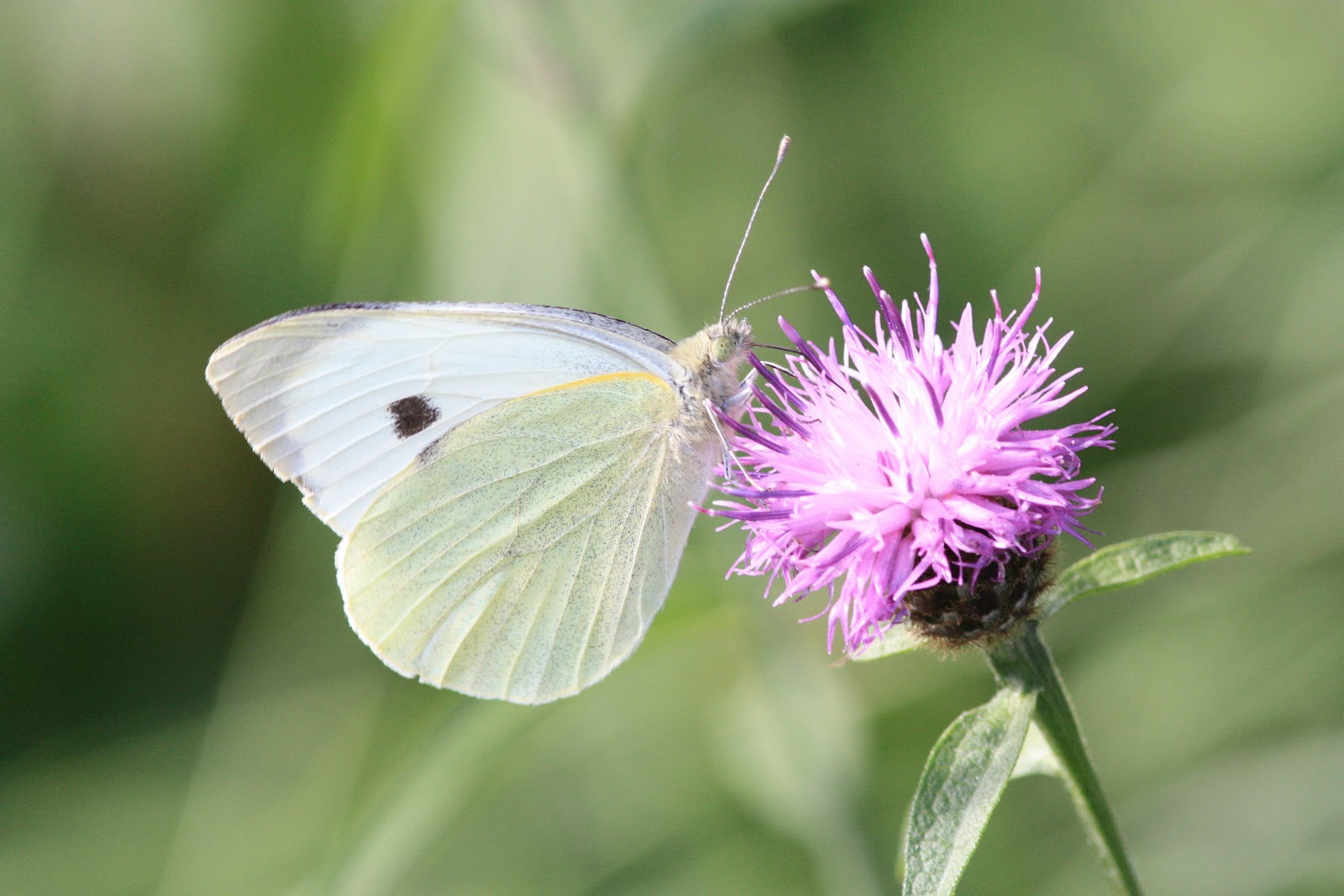
The most obvious habitat feature in the woodland rides was the amount of Common Knapweed, Centaurea nigra. This plant is an excellent source of nectar and pollen for a myriad of invertebrates, its bright pink/purple flowers, reminiscent of a thistle head, being a magnet for butterflies, bees and hover flies.


The butterflies were fairly queueing up...

Small White, Artogeia rapae
Brimstone, Gonepteryx rhamni
A battered-looking Silver-washed Fritillary, Argynnis paphia
As well as the above species, there were Small Skipper, Thymelicus sylvestris; Red Admiral, Vanessa atalanta; Peacock, Inachis io; Speckled Wood, Pararge aegeria; Meadow Brown, Maniola jurtina and Comma, Polygonum c-album.

Our Lass spotted a very late White Admiral, Limenitis camilla, which was foraging for the few remaining Blackberry blossoms that hadn't already turned to fruit.


From the western side of the wood, it was possible to look across the river valley to the centre of town. The numerous roads and housing estates lost amongst the trees and through the foreshortening of the photograph.

Theatre on the left, cinema and ski slope on the right
In the car park, which is in effect a woodland glade, about two dozen Migrant Hawker dragonflies were feeding in a mesmerising aerobatic display. With very little birdsong audible, the only sound was the rustle of dragon wings as the hawkers pulled incredibly tight turns in pursuit of their prey.

Occasionally, a few of their number would roost for a while in the surrounding vegetation, but the  heat of the day meant that they were very flighty and difficult to approach.

Migrant Hawker, Aeshna mixta, female
As we left the wood, down a farm track, a flash of white ahead alerted us to a Wheatear. A different type of migrant, one that has begun its return passage to Africa to spend the Winter in warmer climes. This seemed somewhat odd on the day that the UK hit 30+ degrees C.

Saturday, 18 August 2012

Vegetarian raptor

Staring out of the window whilst breakfasting this morning, Our Lass suddenly called out  "Sparrowhawk!"


Sure enough, one of the scourges of bird tables everywhere had swooped down onto the lawn and seized a Yarrow in its talons. Eh? A vegan raptor on a health kick? Or one seeking to augment the latest Greenfinch with Sunflower Hearts dish with a few choice herbs?

The truth was more prosaic. Though we did not see the intended victim, I suspect that it was a Dunnock, which had taken cover in the only place in the garden that appears to be hawk-proof, a low-growing compact shrub. We've been here before, see this post from November 2010.

To the unimaginative residents of Tense Towers, this plant is known simply as The Dunnock Bush.

Today's attack was less dramatic, and after rummaging about on the fringes of the shrub for a while, the Sparrowhawk gave up and left empty clawed.


A swift perusal of Wikipedia, showed that there aren't, in fact, any solely vegetarian raptors, thought the Palm-nut Vulture comes close.

Thursday, 16 August 2012

Destiny or free will? Er... you choose?

On waking, have you ever discovered a decision ready-formed in your mind, an answer to a conundrum of which you weren't even aware? It hadn't happened to me before this weekend, so it was a bit of a shock.

Mind you, there was the time when I knew I wanted to name our wedding day, but that was whilst fully awake, stuck in a cramped Army minibus, cold, wet and miserable, after a particularly arduous orienteering competition in the Lake District. It's funny how Life grabs you by the collar sometimes, stares unnervingly deeply into your eyes and then raises an inquisitorial eyebrow as if to say, "Now do you understand?"

Anyway, I woke up on Saturday morning, and as my eyes struggled to focus on the grey clouds outside the window, I simply knew that today was a Long Mynd day.

We hadn't visited Shropshire since last October, so the beckoning call of the nearest moorland habitat to Tense Towers was like a klaxon in my head. Fresh air, no tarmac or concrete underfoot and wall-to-wall (OK, not actual walls) Odonata. Bring. It. On.

Our Lass received the news gleefully. She's enjoying a spot of time off at the moment, after completing her course, and was equally keen to sample the heather, bracken and big skies. We bundled the usual accoutrements into the car, breakfasted once we arrived in Shropshire and were gazing at Salopian odes before lunch time.

We spent several hours exploring the water bodies and vegetation at Wildmoor Pool. Golden-ringed Dragonflies, Common Hawkers and Black Darters being the larger insects on the wing. There were plenty of Emerald Damsels, as well as Common Blue and Blue-tailed Damselflies.

Lestes romance
Golden-ringed Dragonfly, Cordulegaster boltonii
We left the Mynd for a while and drove across to the Stiperstones ridge, ending up at a cafe at The Bog, an ex-school room for the mining community that lived and worked here in the 1800s. Make all the jokes you like, but the home bakes are delicious and just up the road is a large pond with the occasional winged jewel.

Having quenched our thirst and sampled the cake, we pottered along the bank of the pond, watching an Emperor Dragonfly, Emerald Damsels and several Common Darters. When we sat on a bench, we shared it with one of the latter, who was only too keen to take advantage of a warm and elevated roosting spot...

Sympetrum striolatum, sat on my hand. The black speck is the remains of a fly that he'd just eaten.
He repeatedly flew off to catch more prey, returning to my hand each time to devour his meal. I just love the fact that the situation was of his choosing, to him I was simply a warm thing at a useful height. I was so blissed out, Our Lass had to take the photo.

Following a brief visit to Pole Cottage and the ditch system, which provided more Common Hawkers, Black Darters and Emerald Damselflies, we drove into Church Stretton and enjoyed a pleasant meal in Berry's. After a postprandial wander through the fields by Rectory Wood, we returned to Tense Towers, listening to the final night of Olympic athletics on the radio. A gold medal day on many levels.

Wednesday, 15 August 2012

Willowherb Wednesday

For a very patient lady...

Greater Willowherb, Epilobium hirsutum
Also known as Codlins and Cream
This plant self seeds in the garden at Tense Towers, but in 2012 it chose a very shaded location. The result was a rather late flowering (I was expecting it weeks ago). Still, a promise has finally been honoured, a weight of expectation lifted, and in a kind of Yin and Yang way, I reckon that would appeal to Mr Cobweb.

Sorry, but if you've not been paying attention, then this post will make even less sense than normal!

Sunday, 5 August 2012

Lift off!

Today was one of those days where you set off with a bit of a plan but things turn out very differently. In a good way!

As we were running low on bird food for the squadrons of finches, tits, doves and pigeons that visit our garden, Our Lass and I decided to head over to The Lodge shop at RSPB HQ to stock up.

Walking up the path to the shop, I texted JD to see if he was about, as he only lives a few miles from The Lodge. It wouldn't do to miss out on the opportunity to hear some Rotton Yarns at first hand.

JD phoned back to confirm his availability and we agreed to pop in after our shopping trip and a quick visit to the gardens of The Lodge.

The main feature of the garden is an old swimming pool that is now home to an impressive array of wildlife, as well as a hungry shoal of carp. Despite the presence of the fish, this pond is excellent for Odonata and, at this time of year, is good for close up views of Small Red-eyed Damselfly. We have this species in Milton Keynes, but it is often out in the middle of large water bodies and not so easily seen.


On our first lap of the garden, cloud cover was keeping the dragons and damsels quiet, so that all we saw was a Migrant Hawker, plus a few Red-eyed, Azure and Blue-tailed Damselflies. Continuing our circuit of the smaller water bodies, the sun finally put in an appearance, so that by the time we returned to the swimming pool pond, some Small Red-eyes were out on the lily pads. I only had the camera on my phone to record images, so didn't attempt a risky leaning-out-over-the-water shot!

Mind you, carefully stalking a Common Darter on a wall delivered impressive results. Just as I pressed the shutter release button, the dragonfly took off, resulting in possibly the best in-flight odo shot I have ever taken.


So why do I usually lug around several kilogrammes of Canon's finest? It's enough to make you weep.

Walking back to the car along a woodland path, I remembered a promise I made to Katie from Nature ID. Following a post about willowherb plants in California on her blog, I said that when next the English varieties were in flower, I would photograph them and post too. To be fair, they aren't a patch on the razzmatazz of the colours of the American species, but my word is my bond.

Rose Bay (Willowherb), Chamerion angustifolium
Some internet sources list this plant as a true Willowherb in the genus Epilobium, either way, it wasn't a common plant in the UK until the expansion of the railway network in the first half of the  19th Century, which helped it to spread. It is often found on waste ground and also goes by the name of bombweed or fireweed.

We do have Great Willowherb, growing in our garden at Tense Towers, but the weather this year has really confused it. It is nowhere near flowering yet. The quest continues.

We met up with JD and explored the fine array of wildlife in his garden at Fort Soixante Neuf. A wonderful spread of corn field annuals harboured all manner of invertebrates, butterflies, moths, beetles, grasshoppers and shield bugs. We then sat by the pond for ages, entranced by all the aquatic goings-on. As thunder rumbled away to the west, we risked setting off on a walk along a few bridle paths in search of butterflies and dragons. JD's excellent route planning ensured that we ended up at an eatery, the Coach House in the town square, where we enjoyed a roast lunch from their Sunday barbeque menu. The only slight downside was the fact that I was driving and couldn't partake of any ale from the local brewery. Oh well, next time :o)