Sunday, 20 November 2011

It is unusual

... if I may misquote Tom Jones.

I'm not just talking about the mild Autumn that Nature is taking to her heart and weaving into some second Spring love.

Here, in the garden at Tense Towers, amongst all the fallen leaves, withered stems and dying vegetation, there are a few subtle signs of this resurgent life. However fleeting this moment, whatever the Winter has in store, it is another reminder of the topsy turvy year we've had.

After the freezing weather at the beginning of 2011, there was an incredibly warm and dry Spring. This was followed by the dampest of damp squib Summers, as cool as a Welsh singing legend and, dare I say it, as wet as one of his knicker-throwing fans. So perhaps the mild Autumn should not have come as such a surprise. It's been a bonkers year for weather.

Our Hawthorn tree shed the last of its leaves several weeks ago, which is as it should be. Whilst sat enjoying our lunch yesterday, Our Lass commented that there appeared to be some new growth at the end of a twig.


Flower buds on the May in mid November? Each little stamen/anther package, a sex bomb.

Though the flower borders are not looking their best at the moment, there is a splash of colour from a plant that I've always known as Orange Hawkweed. Certainly, when I was a mere Tenselet all those years ago, this flower was frequently to be found on railway embankments in the North East of England. 


Some 21st Century research revealed that it is in fact Fox-and-cubs, Pilosella aurantiaca, that should've finished flowering in September. It may be an introduced species from continental Europe, but there's something 'bout you baby I like.

Meanwhile, in the centre of our scraggy lawn, there's this...


Whether it's a fungus or a mould, I don't know? However, I do suspect that it has developed from the remains of an apple thrown out for the birds. All together now... "the grey, green grass of home."

Sunday, 13 November 2011

WWT and FCA

I know, I know. If there's one thing you can't stand it's a TLA*.

Working hard on her latest course, Our Lass has had very little time to relax of late, so one day of this weekend was set aside for some much-needed R 'n' R.

On Saturday morning, we made the trip over to Welney to visit the Wildfowl and Wetlands Trust reserve, have some fresh air and soak up the wildlife. In the evening, we met up with Second Born and JD to attend a gig at the Corn Exchange in Cambridge.

This Autumn, water levels on the WWT reserve have not yet risen sufficiently to flood the meadows, but there were still plenty of birds present. From the Friends Hide, we were able to see a few Egyptian Geese and a pair of Marsh Harriers, the latter sending flocks of waders and ducks skywards in alarm. Whilst in the Lyle Hide, the Admiral spotted a Weasel that was exploring the edge of one of the ditches. This furry bundle of hyperactivity did not stay still for a single second, so my attempted photographs were of a rather blurry nature.

Though the day was fairly overcast, the temperature was mild for November, so we were fortunate to encounter half a dozen Common Darter dragonflies during the day, at what must surely be the tail end of their season.

In the late afternoon, as it grew dark, a flock of Pied Wagtails gathered on the roof of the Visitors' Centre, before descending into a reed bed to roost for the night. We took this as our cue to leave and head towards the bright lights of the city for the evening's entertainment.

It is 35 years since the release of the album 'Frampton Comes Alive' and to mark the occasion, Peter Frampton is touring 'FCA35' and performing the whole album as the first half of his set. I must admit that, back in 1976, I was mainly listening to synthesisers and keyboards, so my interest in this guitar virtuoso only registered a few years ago when Planet Rock played the live version of the track "Do you feel like we do?" All 14 minutes and 15 seconds of it. Therefore, when the chance arose to experience it first hand (or rather, ear), it didn't take too long for JD to persuade me. Despite not knowing much of the second half of the set, we thoroughly enjoyed the night, such was the calibre of the musicianship. The warmth and affection that was apparent between band and audience certainly made it an evening to remember.

* TLA = three letter acronym

Monday, 7 November 2011

Night games

You may be thinking "Early 80s rock track that made it into the UK Top Ten?" or even "Dubious reporting of salacious goings on at Tense Towers?" It's a tough call.

If I said that there's a camera involved, does that help?

Or that names have been changed to protect identities?

OK, last clue, the words "winkle", "bush" and "pussy" will appear in the following text.

You have been warned.

Last month, Our Lass bought me a trail camera, one of those Bushnell models that often appear on tv wildlife programmes. Now, although Tense Towers isn't big enough to possess a trail, I thought it would be interesting to see what was about in the environs after dark. To be honest, in a land where all large predators have systematically been obliterated, the answers are going to be pretty few. Still, hope springs eternal.

My first foray with the device was on a particular wild and windy night (no smirking at the back!) when the movement of the garden vegetation managed to trigger the camera to fill a 1GB card in the 3 hours before the watershed (US = safe harbor). Doh!

The next attempt was a calmer night, in a more sheltered spot and with the sensitivity reduced, resulting in only about 10 frames... mostly empty. Double Doh!

Picking suitable weather and returning to the first location produced some blurry shots of next door's cat, but little else.

Next door's pussy (not full frontal)
The more observant amongst you will have realised that it took me a while to figure out how to set the date/time stamp.

Finally, persistence eventually paid off and I managed to capture a few shots of...

Mrs Tiggywinkle (not her real name)
It's a good job that you lot don't have filthy minds.

Thursday, 3 November 2011

Wildlife and punctuation

Relax, folks, this isn't going to be a punfest involving a certain species of orange butterfly or an investigation into the lower intestine of any particular creature. It's more of a eulogy to a departed soul who I didn't even know before their death, but who is now often in my thoughts.

But first, a little background.

Regular visitors to this blog will appreciate that I'm a bit of a pedant when it comes to the written word. Things have to be just so or it's the end of civilisation as we know it. Unfortunately, this doesn't make me immune to the odd grammatical slip or error of my own. In fact, only today, after commenting on a post, I noticed that a typo had crept into my supposedly carefully-crafted words.

Aaaaarggghhhh! Happily, there were enough people on hand to physically restrain me until the pedantic fit had subsided and, would you believe it, the world hadn't ended. And anyway, re-posting the correct version would have detracted from the sentiment I had been attempting to convey. Stay calm, Tense, stay calm.

Having grown up in a rural setting in the North East of England and, many years later, found myself working in a village surrounded by fields and farms, I am reasonably familiar with thunder flies, those tiny insects that seem to be everywhere at harvest time. Apart from some minor inconvenience when having my concentration temporarily broken, I have never been too bothered about their existence one way or the other. I guess that, on some level, I understood that they were part of the food web, but my thoughts did not run much deeper than that. And I certainly didn't consider their potential as proof reading time bombs.

It's only now, whilst researching for this post, that I discover that they are thrips from the Order Thysanoptera, who have two pairs of feather-like wings. Certain species are pests of economically important crops, especially cereals, which is probably why I have always referred to them as harvest flies, since they swarm in their thousands when the grain ripens.

Inevitably, for such a tiny insect, it can crawl into the smallest of gaps, and so, like many people, I have one stuck in my pc monitor. An ex thrips, (yep, the singular is 'thrips' too, something else I didn't know!) it has been there for over a year. Ages ago, when I first noticed it, it was very much alive, wandering about documents and emails like some randomly mobile comma or dash, depending on whichever direction it was intent upon heading. However, it was not long before the wandering stopped and its sad little body has remained marooned, left justified, two thirds of the way down a page, ever since. I hoped that its end wasn't hastened by having to read my interminable techno-babble, or that it wasn't given a nasty shock on meeting a forest of exclamation marks, but I do feel a twinge of guilt every day, on firing up my computer.

When proof reading documents, I have to remember where it is, lest I become confused by a sudden reference to 'attached' with an accent over the 'e', or on finding an unexpected apost'rophe in a word. More often than not, though, it's located in the wide open spaces between paragraphs, free but not free, hidden but on display.

I was going to take a photograph and upload it to Blogger, but to be honest, would you even know the difference if I just did this... ?


                        '


Rest in P's, little insect.

Sunday, 30 October 2011

A personal wildlife calendar

If you're ever stuck for an idea to kick start a post, it's amazing how inspirational one's fellow bloggers can be. You've got Katie at Nature ID to thank for the seed corn of today's offering. I can only hope that my small corner of the blogosphere is half as good at germinating the tiny shoots of a thought and nurturing it towards maturity.

A couple of months ago, our good friend JD went on holiday to California, principally to go whale-watching with a bunch of like-minded cetacean folk, but also to soak up the general wildlife flavour of the area. I am smiling as I write this, remembering his excited description of finding a rattlesnake in the road as their car rounded a bend. Not long after his return to England, one of his American acquaintances mentioned a trip to the UK, and as one of the planned destinations for the trip was Orkney, I was asked for my thoughts on travel, accommodation, wildlife hotspots etc. It was very difficult to narrow down all our favourite places in the archipelago to a Top Ten, it felt a bit disloyal to some of the spiffing archaeology and scenery that I had to leave out, but rules are rules.

Through the Comments section of a recent Nature ID post, a similar question was raised, along the lines of " When is the best time to visit the UK?" Now that shouldn't take long to answer, I mused, thinking that a swift trawl through the Imperfect and Tense back catalogue would provide the necessary information. Well, it's been several days now, and I don't even know where to start. Talk about painting oneself into a corner. I guess the bottom line is that there is not just one answer, it will be different for everyone, so I will have to use a broad brush and produced a generalised, if personal, picture.

The quick answer is "Summer!", so chronologically that's June to August. This guarantees the most daylight during the summer solstice in late June or, theoretically at least, some hot weather in August. But that is likely to be when everybody else is on holiday too.

Autumn is great for all that mellow fruitfulness (September) with hedgerows resplendent in their sweet harvest, whilst the slowly-changing leafy palette of October can be a spectacle all in itself. The light can be gorgeous first thing in the morning or last thing in the evening. November often brings the first hard frosts and huge numbers of winter migrating birds from Iceland, Scandinavia and beyond.

Thinking of Winter, I can only recall that snow is more or less guaranteed in early February (though now I've said that... ). However, the last two winters have been colder than the norm, so it is possible that the frozen fractals could settle at any time. The landscape is softened, sounds are dampened and the crump, crump, crump of footfalls in the snow always gladdens my heart. Especially if there's any chance of a glass of mulled wine.

But regular readers will know that good ol' Tense can only recommend one time to visit the UK. Need a clue? It begins with 'S...' and ends in '... pring'. Just think of all the new life that emerges from the icy remnants of February and gathers pace through March and April. It hits the ground running in May, and by careful application of chasing it north, can last until the end of June. The arrival of summer migrating birds to swell the orchestra of the dawn chorus, the precious meadows where wild flowers can still be found and the fluttering roll call of colourful winged insects [contented sigh].

Certainly in this area of England, the last week of April or the first week in May will be optimum bluebell time (at least, that's what my posts reveal). Again, the beginning of May is when the dawn chorus is at its peak, especially those prima donnas the Nightingales! Through the month, the green hue of the landscape is at its best and I have to send for sedatives if I wander into a beech wood and experience dappled shade. Towards the end of May, the first broods of Great Spotted Woodpeckers are noisily emerging from their nest holes and in the glades and fields, the orchid season is well under way. June sees an increase in the numbers of dragonflies on the wing and the heartache of watching that agile falcon, the Hobby, as it swoops and turns above a lake in the evening light, feeding upon their bounty. I do have a very strong Spring-centric bias, I'm afraid.

Honourable mentions must go to February and March for boxing Hares and dancing Great Crested Grebes. And to November, for huge flocks of Starlings performing amazing aerial displays before roosting for the night.

I am sure that these wonders are not limited to the UK, but as my time abroad has not had a wildlife focus, I cannot say. Best come and check for yourself!

Monday, 24 October 2011

AutumnMunch

The Admiral and I have been on a boys' weekend in Devon, ostensibly to attend the British Dragonfly Society's Members' Day 2011, this year held at the Dame Hannah Rogers Trust's Seale-Hayne campus, near Newton Abbot.

During our journey south on Friday, we were fortunate to spot an Osprey flying over Dyrham Park, a National Trust property near Bath. The return trip was even more eventful with a visit to the Wildfowl and Wetlands Trust reserve at Slimbridge. I've undoubtedly whinged before about this being nothing short of a duck zoo, but it came up trumps on Sunday, with some proper wildlife in the form of a Spoonbill, a Peregrine Falcon and flocks of Black-tailed Godwits and Barnacle Geese. Shame I didn't have Very Wrong Len with me, really. Oh, and three Migrant Hawkers, for good measure.

The staff are also creating an imaginative wildlife garden, of which I was able to capture a few images, before I was enthralled by the siren song of the tea shop.

Excellent use of a redundant shipping container
Ingenious bug houses/wildlife stacks

Tuesday, 18 October 2011

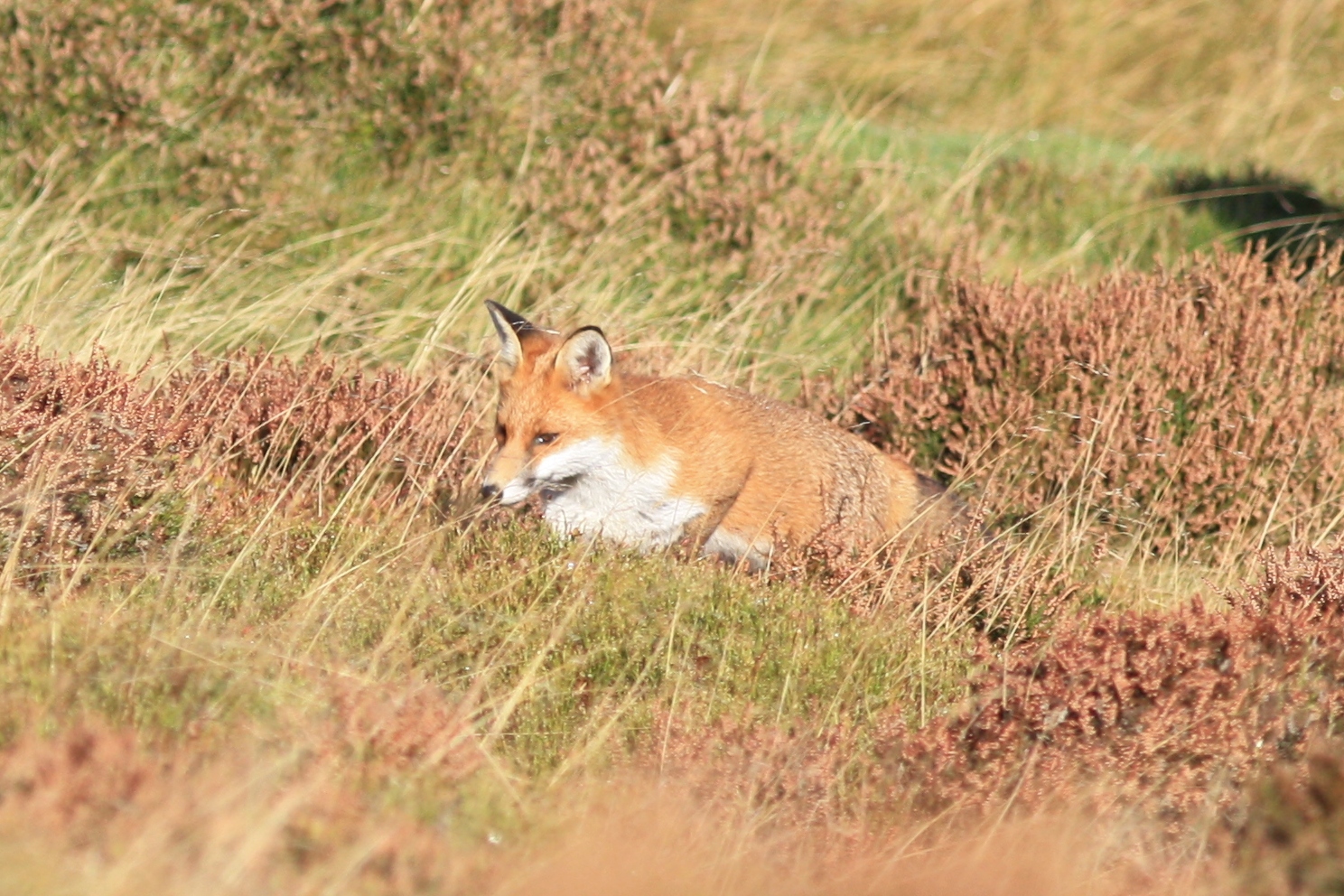
Fox "unconcerned" by latest report

The last morning of our stay in Shropshire was a story of ever-changing light. Setting off from the village of Hope Bowdler in cold, damp, overcast conditions, we drove the mile or so down into Church Stretton, where patches of blue sky were evident. By the time we were negotiating the steep hill up onto the Long Mynd, the car was bathed in bright sunshine.

As the single track road wound its way steadily higher, Our Lass suddenly stopped the car and pointed to my left. There, a few metres away, was a fox, busy hunting prey in the grass and heather. It wasn't too sure whether we were a threat or not, and would start to slink away but then return to whatever it had found.

As my camera was in the boot and our car was blocking the road, we continued on over a slight rise and found a parking spot. Now out of sight of the fox, we decamped, grabbed optics and I made my way cautiously along a sheep track back in the direction we had come.

Fortunately, the sun was now behind me, but not such good news, so was the breeze. Once in roughly the right area, I risked a peek over the ground where we had seen the fox. Sure enough, it was still there, rummaging through the vegetation in search of a meal. As it turned out, it wasn't important whether I was in lupine eye or nose range, when my camera shutter fired, my cover was blown. I managed two images before the fox, now alert to my presence,  lazily wandered off, between some equally unconcerned sheep.


The country air obviously suited him. He was a very healthy individual in comparison to the urban foxes we see in MK.

After all that excitement, we returned to the car and continued to the top of the Mynd, which was rather busy for 10am on a Sunday morning. It is a popular place for ramblers, joggers, mountain bikers and horse riders, as well as those soaking up the natural history. Walking north along the ridge, we spotted a Red Kite, a few Buzzards, many Ravens and a flock of 200+ Golden Plover. These waders continued to circle overhead, their plaintive contact calls drifting in and out of earshot as they wheeled around and around. As the light continued to change with the amount of cloud cover, bright and blue one minute and then dark and foreboding the next, the plumage of the plovers seemed to dazzle and sparkle, allowing the birds to stand out against the sky, and then suddenly they were tiny grey dots, hardly detectable unless you knew where they were.

Looking east from the Long Mynd, we could make out ridge after ridge all the way to Abdon Burf, one of the Clee Hills, on the horizon. The mist and low cloud in the valleys added to a sense of otherworldliness, though the wild ponies in the foreground weren't too bothered at all.


It was with heavy hearts that we reluctantly headed back home, though I am sure it won't be long before we return to South Shropshire and its secret hills.