This particular post is very current, as I only downloaded the track in question this week. The tune is about four or five years old, so maybe I'm not any sort of up-to-date, happening, finger-on-the-pulse, music aficionado. But here's the story of the serendipitous sojourn which brought the song to my auditory cortex.
On Tuesday morning, I received an email from a blogging colleague, which contained a few links to things I would find interesting. One of these links was to a short film of lightning storms, shot with a super high speed camera (1000 frames a second). I wasn't able to watch it immediately but, later that evening, I remembered the email as I was sat waiting for the overnight ferry from Orkney to Shetland. So there I was, at 11pm, staring intently at my phone screen in a dark car park at Hatston terminal. It was quite arty, very crisp, nicely sound tracked and I did indeed find it interesting. If you want to marvel at the cinematography and technical expertise, here's the link but, mind on, due to the content, it does contain flashing lights.
Now, there's a couple of other things you should know...
The music on that film isn't what this post is about. And my phone was set, to my chagrin, to play the next video of Vimeo's choosing.
As it turned out, this was another super high speed movie, by the same photographer, which featured a motor bike stunt rider, fireworks and ticker tape. All very impressive when shot using this equipment. Unfortunately, these weren't the only subjects of the film, as centre stage were several scantily-clad ladies... on trampolines. Now there's an image that will be difficult to unsee.
However, it was the accompanying music which grabbed my attention, and before boarding the ferry I had already downloaded the song, 'Dernière danse' by Indila, from her 'Miniworld' album of 2014. It was a huge hit around Europe but, I guess, less so in the UK and USA as it is not sung in English.
Being a lad from County Durham, quite interested in the history of my region, and not one to usually bear a grudge, I must admit that I have struggled with France. At school, we were taught all about the Romans and the Vikings, but then skipped to European history of more modern times. It was only later that I discovered about the Harrying of the North which took place after the Norman Conquest in the 11th Century, when William and his troops laid waste to much of northern England, including County Durham. Some historians have described this episode as genocide.
So, on one level, for no particular logical or personal reason, I have struggled with all things French (and, yes, I do appreciate that the Normans were just another bunch of Vikings).
Laying these ghosts to rest has taken some time. However, the novels of Joanne Harris have certainly helped, the film 'Chocolat' was an absolute delight, I then had a bit of a setback with Thierry Henry's handball against Ireland in 2009, but 'Dernière danse' has completed the healing process.
Sunday, 21 October 2018

Saturday, 20 October 2018
Cygnus x 100
No photos of the fleetingly-seen Dunnock, I'm afraid.


But the Redwings just keep on coming, and a couple of Fieldfares deigned to show up too.
Then, a noise we'd been hearing all afternoon, whilst we concentrated upon more mundane matters, made itself felt. Opening the window further, we realised that it was the sound of Whooper Swans, newly-arrived from Iceland and refuelling before heading further south. We couldn't see them, so figured they were either foraging in a field down the hill, or maybe gathering on Graemshall Loch.
Jumping in the car, we drove in the general direction of the whooping, without recourse to a road map for the route to swanage. Sure enough, on Graemshall Loch, there were about twenty families of Whoopers, maybe 100 swans in all, busy socialising, feeding and preening.
We parked up and just enjoyed the sight and sounds of wildfowl and waders, as the fading light lent an atmospheric feel to the scene. Some gentle whistling indicated the presence of Wigeon and several wisps of Snipe burst into the air, but before I could voice a query of "I wonder why they did that?" a Hen Harrier glided by as sufficient explanation.
I've not seen a Swallow for a day or two, and wildlife-y chat is turning to the subject of Grey Seal pups on the nursery beaches of the islands. These are the things, rather than deciduous leaf colour, that tend to illuminate an Orcadian Autumn.


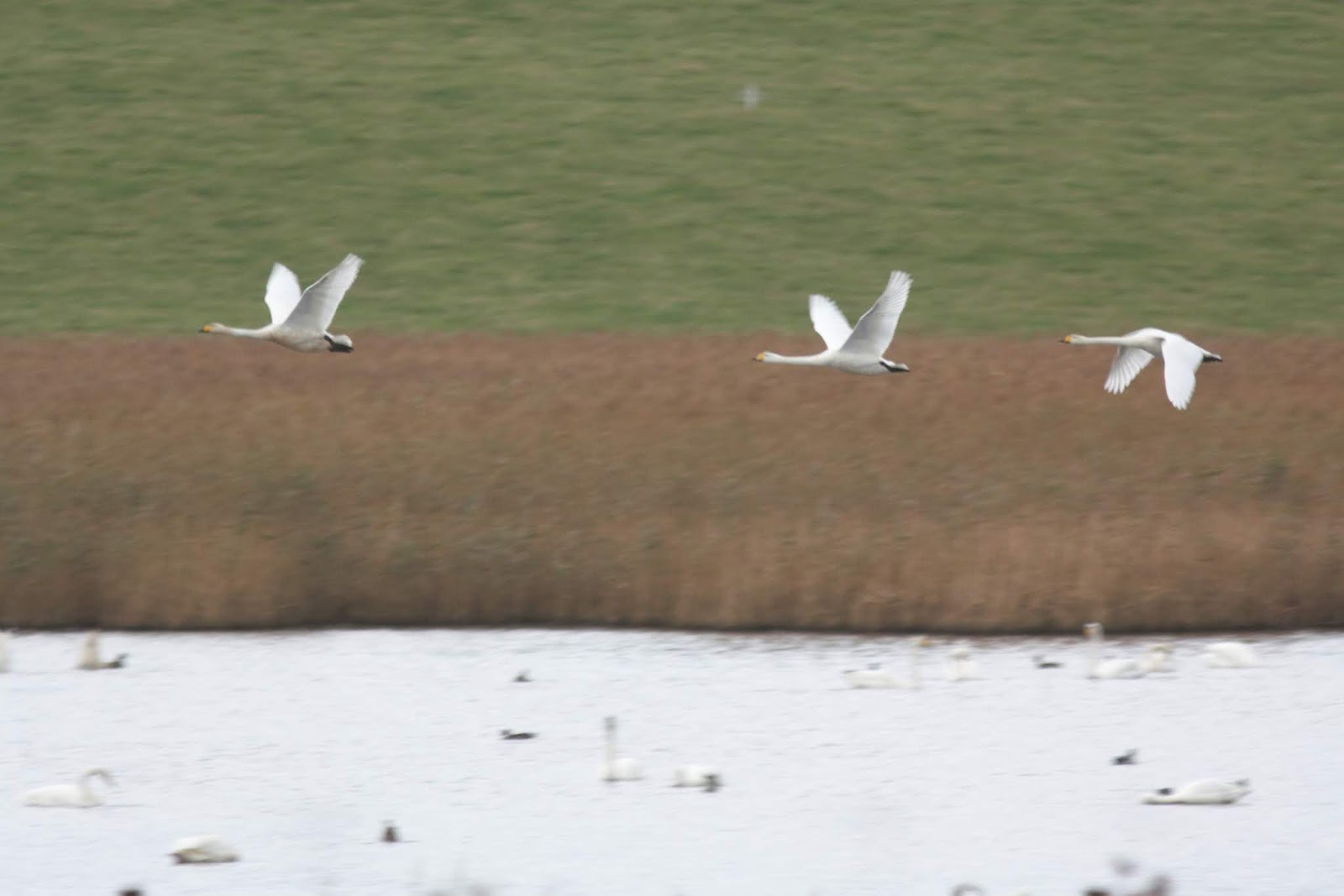
Fans of the Canadian rock band Rush may appreciate the pun in the blog title. 'Cygnus X-1' was the black hole featured in their eponymous track, whilst Cygnus cygnus is the Latin binomial for Whooper Swan. Researching this, I have just realised that the starship of the song's hero is named after Don Quixote's horse, Rocinante. Live and learn.
Remember this day
Mark the date...
Saturday 20th October 2018...
An absolutely monumental occurrence...
And I can say I was there...
Ladies and Gentlemen, I can confirm that, today, I have added Dunnock to the Tense Towers garden list. Whoop, whoop! Go me!
Tuesday, 16 October 2018
Visual migration, no bones about it
The Autumn migration of birds from their Summer breeding grounds further north to areas south where they will overwinter has been eagerly awaited by birders in Orkney. With the recent weather giving alternate days of wet/windy then calm/sunny in a repeating pattern, it would seem that this migration is now well under way.
The local 'bird alert' text service was in overdrive, with ever more rare species being discovered along (mainly) the east coast of the archipelago. Whilst we only live a scant half a mile from the nearest bit of shoreline, this isn't to the east, that coast is probably about two miles away. Therefore, we don't experience quite the same level of feather-induced adrenalin tickling our fancy. But that's not to say we're immune from upping the amount of 'staring out of the window in hope'.
And, amazingly, this tactic actually paid off in a way. As I wandered out of the bathroom and down the corridor to the lounge, I glanced left across our bedroom, through the window and out to the garden and fields beyond. There on a fence post was a Blackbird... no, not a Blackbird, a black bird... with a white chest band! Holy moly, a Ring Ouzel! I'd not seen one of those in Orkney before, and certainly not from our home. It was gone in an instant, sadly, so no time to rush for my camera or summon Our Lass.
As it was a lovely morning, we decided to go for a wander and, as we donned boots at the front door, a pair of birds called from overhead. I glanced at Our Lass in a 'I don't recognise that' sort of way and we both brought our binoculars to bear on the unidentified twosome as they landed, conveniently, on a nearby fence.
Bramblings! Further scanning brought us a Song Thrush and several Chaffinches (yep, we only see them on migration). Swallows were hunting around cattle in the pastures, and small flocks of Skylarks were happily burbling to one another as they swooped down to feed in the stubble fields. In some respects, we would have been better off staying at home, as the walk only brought us a couple of more Bramblings, a Robin and several Chiffchaffs (all seen from the road as we passed folks' gardens).
Bizarrely, I was quite envious of the Robin, as we hadn't yet seen one at Tense Towers in the second half of 2018.
The following day was dreich, so staring out of the lounge window (through the now cleaned glass!) brought no new sightings. Forlornly, I gave up and wandered into the kitchen to make a brew, which was quite fortuitous, as this was the window through which I should've been looking. My garden project has spent another year not happening, so the silage wrap and worn tyres are still in place. You may recall that we had a Snipe visiting last Winter? Well, whether it was the same one, I don't know, but it brought a friend.


Not a rare bird by any means (they breed locally), but to have such great and prolonged views was a treat and a half. And, several days later, I finally managed to spot a Robin transiting through our garden!
With the rain continuing into the afternoon, I resolved to promote marital harmony and set to a task which I had been putting off for over a year. Early in 2017, whilst working on the island of Eday, I had been given an owl pellet (as compensation for not seeing the bird that regurgitated it!), and the pellet had sat in our kitchen ever since. I fully acknowledge the forbearance shown by Our Lass in regards to this situation, but enough is enough, eh?
The bird in question was a Snowy Owl, so the pellet wasn't small like the ones I'd previously dissected from a Spotted Flycatcher, a Barn Owl or a Kestrel. Those latter two had often contained mouse or vole skulls, so what would I find in this furry grey lump?

Well, aside from all that grey fur, which was probably the big clue, there were many vertebrae from a mammal much bigger than a mouse, or even an Orkney Vole. I'd say probably a Rabbit, as the local records centre doesn't have any data for Brown Hare on Eday.

And, yes, I have washed my hands before typing this.
The local 'bird alert' text service was in overdrive, with ever more rare species being discovered along (mainly) the east coast of the archipelago. Whilst we only live a scant half a mile from the nearest bit of shoreline, this isn't to the east, that coast is probably about two miles away. Therefore, we don't experience quite the same level of feather-induced adrenalin tickling our fancy. But that's not to say we're immune from upping the amount of 'staring out of the window in hope'.
And, amazingly, this tactic actually paid off in a way. As I wandered out of the bathroom and down the corridor to the lounge, I glanced left across our bedroom, through the window and out to the garden and fields beyond. There on a fence post was a Blackbird... no, not a Blackbird, a black bird... with a white chest band! Holy moly, a Ring Ouzel! I'd not seen one of those in Orkney before, and certainly not from our home. It was gone in an instant, sadly, so no time to rush for my camera or summon Our Lass.
As it was a lovely morning, we decided to go for a wander and, as we donned boots at the front door, a pair of birds called from overhead. I glanced at Our Lass in a 'I don't recognise that' sort of way and we both brought our binoculars to bear on the unidentified twosome as they landed, conveniently, on a nearby fence.
Bramblings! Further scanning brought us a Song Thrush and several Chaffinches (yep, we only see them on migration). Swallows were hunting around cattle in the pastures, and small flocks of Skylarks were happily burbling to one another as they swooped down to feed in the stubble fields. In some respects, we would have been better off staying at home, as the walk only brought us a couple of more Bramblings, a Robin and several Chiffchaffs (all seen from the road as we passed folks' gardens).
 |
| Pretty sure this a Chiffchaff |
The following day was dreich, so staring out of the lounge window (through the now cleaned glass!) brought no new sightings. Forlornly, I gave up and wandered into the kitchen to make a brew, which was quite fortuitous, as this was the window through which I should've been looking. My garden project has spent another year not happening, so the silage wrap and worn tyres are still in place. You may recall that we had a Snipe visiting last Winter? Well, whether it was the same one, I don't know, but it brought a friend.


Not a rare bird by any means (they breed locally), but to have such great and prolonged views was a treat and a half. And, several days later, I finally managed to spot a Robin transiting through our garden!
With the rain continuing into the afternoon, I resolved to promote marital harmony and set to a task which I had been putting off for over a year. Early in 2017, whilst working on the island of Eday, I had been given an owl pellet (as compensation for not seeing the bird that regurgitated it!), and the pellet had sat in our kitchen ever since. I fully acknowledge the forbearance shown by Our Lass in regards to this situation, but enough is enough, eh?
The bird in question was a Snowy Owl, so the pellet wasn't small like the ones I'd previously dissected from a Spotted Flycatcher, a Barn Owl or a Kestrel. Those latter two had often contained mouse or vole skulls, so what would I find in this furry grey lump?

Well, aside from all that grey fur, which was probably the big clue, there were many vertebrae from a mammal much bigger than a mouse, or even an Orkney Vole. I'd say probably a Rabbit, as the local records centre doesn't have any data for Brown Hare on Eday.

And, yes, I have washed my hands before typing this.
Sunday, 7 October 2018
Ghosts, gulls and gills
For the past four years, a volunteer team of divers have journeyed to Orkney for a week to spend time carefully removing lost fishing gear from the waters of Scapa Flow. This is the Ghost Fishing UK project, which I became aware of back in 2015, when the re-use yard where I was working was asked to help with recycling some of the retrieved gear, to prevent it going into landfill. This year, as well as training new divers, the team organised a talk in Stromness Town Hall, to let local folk know about their work, and fund raise for future projects.
Our Lass and I went along, to hear the various speakers talking about Ghost Fishing UK, World Animal Protection and research into micro-plastics by academics from the International Centre for Island Technology.
At this point, we hadn't watched the BBC documentary 'Drowning In Plastic', but with that harrowing experience yet to come, it was a little reassuring to know that work is being done by dedicated professionals and volunteers, at both local and international levels, to try to remedy the problem of plastic pollution of the oceans.
Also this week, I attended an evening talk, arranged by the local branch of the Scottish Ornithologists Club, about a Lesser Black-backed Gull tracking project (Tag 'n' Track) being run by the ranger team at Clyde Muirshiel Country Park, west of Glasgow. Data obtained from the GPS tags fitted to the gulls, helped explain their movements in the local area during the breeding season, and also where the gulls migrated to during the Winter (Portugal and West Africa).
On Friday evening, we sat down to watch the 'Drowning In Plastic' documentary, a programme that leaves the viewer in no doubt just how utterly and completely humans have fucked up the oceans. I'm sorry for my coarseness, but how else can one react to the volume of plastic pollution pouring into the environment, or the equally horrific volume of plastic inside the stomachs of marine animals. I will not be able to look at a sea bird colony in quite the same way ever again, knowing that the crowded rock ledges of auks and gulls are really innumerable individual conglomerations of plastic fragments. And, I guess, whenever a marine animal dies (be it a fish, a turtle, a bird, or a seal), as its forlorn remains decompose, those same pieces of plastic will be released back into the ocean, to inflict yet more harm to wildlife. Some days there just aren't enough expletives.
We ended the week on a slightly more upbeat note, by going along to a Fungi Foray organised by the Orkney Field Club. On a surprisingly calm and mild Autumnal morning, the local fungi recorder gently ushered a group of fourteen of us around the clifftop habitat of the Mull Head Nature Reserve in Deerness. Whilst not typical fungi habitat (the outing is usually held in Binscarth Wood, I believe), the grassland and maritime heath of Mull Head is an area which is under-recorded for this taxon. During an entertaining and informative wander, we found ten different types of fungi, a few of which were identifiable to species, the others to probable Genus. The star find was some coral fungus, discovered under a diminutive stand of Dwarf Willow.
I shall leave you with this thought... please think about the plastic in your lives. We can't make it disappear overnight, but we can endeavour to reduce our use and re-use or recycle where possible.
Our Lass and I went along, to hear the various speakers talking about Ghost Fishing UK, World Animal Protection and research into micro-plastics by academics from the International Centre for Island Technology.
At this point, we hadn't watched the BBC documentary 'Drowning In Plastic', but with that harrowing experience yet to come, it was a little reassuring to know that work is being done by dedicated professionals and volunteers, at both local and international levels, to try to remedy the problem of plastic pollution of the oceans.
Also this week, I attended an evening talk, arranged by the local branch of the Scottish Ornithologists Club, about a Lesser Black-backed Gull tracking project (Tag 'n' Track) being run by the ranger team at Clyde Muirshiel Country Park, west of Glasgow. Data obtained from the GPS tags fitted to the gulls, helped explain their movements in the local area during the breeding season, and also where the gulls migrated to during the Winter (Portugal and West Africa).
On Friday evening, we sat down to watch the 'Drowning In Plastic' documentary, a programme that leaves the viewer in no doubt just how utterly and completely humans have fucked up the oceans. I'm sorry for my coarseness, but how else can one react to the volume of plastic pollution pouring into the environment, or the equally horrific volume of plastic inside the stomachs of marine animals. I will not be able to look at a sea bird colony in quite the same way ever again, knowing that the crowded rock ledges of auks and gulls are really innumerable individual conglomerations of plastic fragments. And, I guess, whenever a marine animal dies (be it a fish, a turtle, a bird, or a seal), as its forlorn remains decompose, those same pieces of plastic will be released back into the ocean, to inflict yet more harm to wildlife. Some days there just aren't enough expletives.
We ended the week on a slightly more upbeat note, by going along to a Fungi Foray organised by the Orkney Field Club. On a surprisingly calm and mild Autumnal morning, the local fungi recorder gently ushered a group of fourteen of us around the clifftop habitat of the Mull Head Nature Reserve in Deerness. Whilst not typical fungi habitat (the outing is usually held in Binscarth Wood, I believe), the grassland and maritime heath of Mull Head is an area which is under-recorded for this taxon. During an entertaining and informative wander, we found ten different types of fungi, a few of which were identifiable to species, the others to probable Genus. The star find was some coral fungus, discovered under a diminutive stand of Dwarf Willow.
I shall leave you with this thought... please think about the plastic in your lives. We can't make it disappear overnight, but we can endeavour to reduce our use and re-use or recycle where possible.
Saturday, 6 October 2018

Friday, 5 October 2018
Whither the weather
Looking from within, it's difficult to tell, but would you say that the rest of the world glances at Britain and thinks, "There's a bunch of folk preoccupied with the weather."? It's a stereotype that's hard to shake off... unlike the raindrops, snowflakes and hailstones.
(And, yes, at the moment, the rest of the world probably also thinks several other things about Britain. Some things more uncertain and foggier than others, and with little chance of a ray of sunshine any time soon).
Our fascination with the weather comes from, I guess, being a small island located off the coast of a large continent. Whatever meteorology happens by, the only constant is that it will be changing frequently. Hence our need to discuss it at the drop of an oilskin hat.
Now imagine an even smaller island, located off the coast of said small island and ramp up the speed of change. Not to mention the speed of the meteorology!
That's where we are now... equinoctial gales and unsettled weather. After such a glorious Summer, it comes as something of a shock when the sky returns to default settings (though less annoying than when your Sky does a factory reset and loses all your recordings. I'm guessing here, as I'm too tight to pay for all that malarkey).
It's a time of many rainbows... single arcs, double arcs, arc fragments, diffuse arcs... plenty of arc-itecture, really. Although maybe we have the same amount as everyone else, just we also have the big skies which allows us to see them?


But, as I alluded to earlier, these features are ephemeral, as is the weather which produces them. It's never too long before something else rattles through.

Perhaps those weren't good examples, there's patently nine hours between the last two photos, which were taken from the same spot.
(And, yes, at the moment, the rest of the world probably also thinks several other things about Britain. Some things more uncertain and foggier than others, and with little chance of a ray of sunshine any time soon).
Our fascination with the weather comes from, I guess, being a small island located off the coast of a large continent. Whatever meteorology happens by, the only constant is that it will be changing frequently. Hence our need to discuss it at the drop of an oilskin hat.
Now imagine an even smaller island, located off the coast of said small island and ramp up the speed of change. Not to mention the speed of the meteorology!
That's where we are now... equinoctial gales and unsettled weather. After such a glorious Summer, it comes as something of a shock when the sky returns to default settings (though less annoying than when your Sky does a factory reset and loses all your recordings. I'm guessing here, as I'm too tight to pay for all that malarkey).
It's a time of many rainbows... single arcs, double arcs, arc fragments, diffuse arcs... plenty of arc-itecture, really. Although maybe we have the same amount as everyone else, just we also have the big skies which allows us to see them?


But, as I alluded to earlier, these features are ephemeral, as is the weather which produces them. It's never too long before something else rattles through.

Perhaps those weren't good examples, there's patently nine hours between the last two photos, which were taken from the same spot.
Subscribe to:
Posts (Atom)