After a morning sat at a computer (as the forecast had been for a day of rain), I realised that the cloud had lifted, the mist had rolled away and the sun was shining.
Well, you can't waste that!
I drove across the Barriers to South Ronaldsay and along to Hoxa, where there are a few pools of odonatological interest. The first, an abandoned quarry, now flooded, was very different from my visit last year. In fact, I suspect it was probably very different from last week, as the ditch at the 'shallow' end which the damselflies normally frequent had been recently excavated to increase the water flow. Whilst the habitat wasn't totally trashed, it will take a while for it to return to prime damsel territory, and consequently I only spotted one very old Blue-tailed Damselfly.
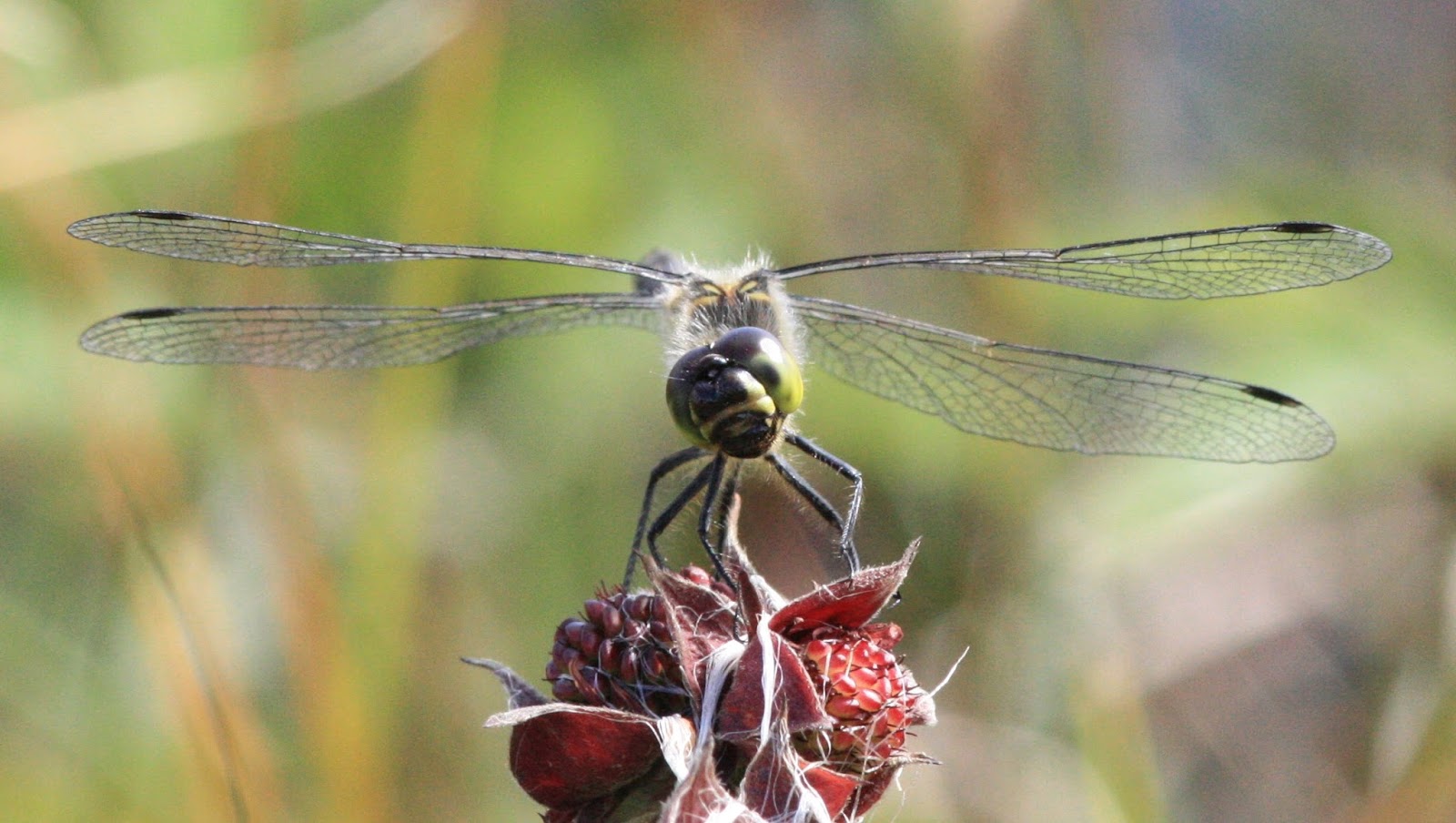
The second site is a collection of bog pools either side of a single tracked road. Following last night's downpours, there were even more pools then usual! The sun was really quite hot, at least for Orkney, and it didn't take long to find a pristine male Black Darter. This gave me much pleasure, as I hadn't personally seen this species at this site before. In previous years, I had been facing the wrong way when Our Lass spotted one. Twice.
There were also a few Blue-tailed Damselflies here too, who must have had a pretty rough night with the weather, being such slender creatures.
But it was the dragons that made me smile...
Before long, the clouds rolled in again, the temperature fell and normal Orcadian service was resumed.
Wednesday, 3 August 2016
Jacob's Ladder
August has kicked off with more of those crepuscular ray evenings.
I notice that one of the colloquial names for this phenomenon is 'Jacob's Ladder', which is coincidentally the name of a track by Rush, a Canadian rock band, whose music is often entwined with happenings at Tense Towers*.
'Jacob's Ladder' is featured on their Permanent Waves album, along with 'Natural Sciences' which popped up in the Comments section of a recent blogpost, thanks to some prompting by fellow blogger Mark.
Lyrics for Jacob's Ladder.
* Most evenings, just after ten past nine, do you notice that it's 2112? No? Just me, then.
Sunday, 31 July 2016
National Dragonfly Week 2016
It has been National Dragonfly Week, 23rd-31st July 2016.
Y'know, I wasn't sure that the dates which work for most of the UK would be the ones that produced best results for Orkney. We're a long way from the median point and so far along the bell curve that the word 'rim' wouldn't be inappropriate (admittedly, I am informed that it can be inappropriate, but I don't think that has anything to do with dragonflies. Do not Google it!).
In an effort to tease out the truth from years of accumulated data, I number-crunched a quarter of a century's Odonata records for Orkney to see when the peak flight period would be for the maximum number of species. Surprisingly, for 59 degrees North, it was the last two weeks of July and the first two weeks of August. So much for my hunch, then.
As part of the Orkney Field Club's programme of Summer events, I volunteered to lead two dragonfly walks, one at either end of the week, to encourage folk to take an interest in these fascinating insects, with the longer term aim of increasing the number of records for the various species that breed here. This provides information for the local Wildlife Records Centre (OWIARC), as well as the British Dragonfly Society.
First up, I have to say that despite the dates being bang on for odes, no-one told the Met Office. Neither walk featured anything that could be described as direct sunshine, which is a much-required feature of your average dragonfly walk. Still, undaunted, we managed to record a combined total of six species of dragonflies and damselflies (75% of the Orcadian assemblage) during the week.
Dragonfly Walk 1 - Lyness, Hoy - participants 3
The first walk involved a ferry trip across Scapa Flow to the island of Hoy. I had recced a walk from the ferry port in Lyness up a nearby hill, Wee Fea, so that we didn't need to book a car onto the boat. As well as being good for the event's carbon footprint, this also freed up personal budget for tea and cake.
The day was overcast, not too windy and not too cold, but I have to admit that the lack of sunshine was a concern. Upon reaching the pools on the southern flank of Wee Fea, it took a while to spot our first ode, as everything was hunkered down in the Soft Rush (it helps if one of the attendees is the local whizz on Flora and can identify the vegetation!) growing at the water's edge. But, with a bit of dedication, we were able to find three species of damselfly: Emerald, Common Blue and Large Red. In fact, on the one occasion that the sun almost broke through the clouds, the temperature rocketed up several degrees and the Common Blues were then visible, flying close to the surface of the water, as males searched for mates.
As the group's dragon detecting improved, we also found a number of Black Darter dragonflies, and even had a flyby from a Common Hawker.
On our descent from Wee Fea, we stopped off at another pool, across some rough pasture, managing to find more Emeralds and also some Blue-tailed Damselflies.
With the time approaching for the return ferry trip, we nipped into the Scapa Flow Museum to take advantage of their cafe, but sadly it was closed due to a family emergency. Instead we just had time to investigate the pond next to the museum, and recorded more Blue-tails and a pair of mating Emeralds.
Dragonfly Walk 2 - Russadale, Stenness - participants 9
The second walk was on the Mainland, to a quarry pool in Russadale, tucked away in the hills above Stenness village. If anything, the weather was worse. Following a night's heavy rain, the rough track up to the quarry was quite water-logged and, when we reached our destination, there were more pools as well as the one I was expecting. The group began looking for odes immediately, which paid instant dividends when a recently-emerged Black Darter was spotted, clinging to its empty larval skin on a rush stem. The dragonfly's wings were still shut above its thorax, rather than their final position of out to its sides. We did wonder whether the moisture from the rain was causing more surface tension than the darter's flight muscles could overcome. All through a downpour, we searched the vegetation alongside and in the water, coming up with at least four Blue-tailed Damselflies.
As we continued to monitor the progress of the Black Darter, it clambered up the rush stem and opened its wings, but this ramped up the amount of buffeting it received from a northwesterly wind, so it closed them again. Satisifed that we could leave it in peace and not worry about surface tension, we sploshed back down the hill (through even bigger puddles), with me absolutely chuffed that we'd seen anything at all.
In Other News...
The big highlight of Orkney's Dragonfly Week had nothing to do with me, and was the discovery of a Black Darter on Eday, a first for the island. Well Done to Eday Ranger Kate Townsend for an excellent find!
Y'know, I wasn't sure that the dates which work for most of the UK would be the ones that produced best results for Orkney. We're a long way from the median point and so far along the bell curve that the word 'rim' wouldn't be inappropriate (admittedly, I am informed that it can be inappropriate, but I don't think that has anything to do with dragonflies. Do not Google it!).
In an effort to tease out the truth from years of accumulated data, I number-crunched a quarter of a century's Odonata records for Orkney to see when the peak flight period would be for the maximum number of species. Surprisingly, for 59 degrees North, it was the last two weeks of July and the first two weeks of August. So much for my hunch, then.
As part of the Orkney Field Club's programme of Summer events, I volunteered to lead two dragonfly walks, one at either end of the week, to encourage folk to take an interest in these fascinating insects, with the longer term aim of increasing the number of records for the various species that breed here. This provides information for the local Wildlife Records Centre (OWIARC), as well as the British Dragonfly Society.
First up, I have to say that despite the dates being bang on for odes, no-one told the Met Office. Neither walk featured anything that could be described as direct sunshine, which is a much-required feature of your average dragonfly walk. Still, undaunted, we managed to record a combined total of six species of dragonflies and damselflies (75% of the Orcadian assemblage) during the week.
Dragonfly Walk 1 - Lyness, Hoy - participants 3
The first walk involved a ferry trip across Scapa Flow to the island of Hoy. I had recced a walk from the ferry port in Lyness up a nearby hill, Wee Fea, so that we didn't need to book a car onto the boat. As well as being good for the event's carbon footprint, this also freed up personal budget for tea and cake.
The day was overcast, not too windy and not too cold, but I have to admit that the lack of sunshine was a concern. Upon reaching the pools on the southern flank of Wee Fea, it took a while to spot our first ode, as everything was hunkered down in the Soft Rush (it helps if one of the attendees is the local whizz on Flora and can identify the vegetation!) growing at the water's edge. But, with a bit of dedication, we were able to find three species of damselfly: Emerald, Common Blue and Large Red. In fact, on the one occasion that the sun almost broke through the clouds, the temperature rocketed up several degrees and the Common Blues were then visible, flying close to the surface of the water, as males searched for mates.
As the group's dragon detecting improved, we also found a number of Black Darter dragonflies, and even had a flyby from a Common Hawker.
| Wee Fea pool. Photo: Our Lass |
| Black Darter. Photo: Our Lass |
On our descent from Wee Fea, we stopped off at another pool, across some rough pasture, managing to find more Emeralds and also some Blue-tailed Damselflies.
With the time approaching for the return ferry trip, we nipped into the Scapa Flow Museum to take advantage of their cafe, but sadly it was closed due to a family emergency. Instead we just had time to investigate the pond next to the museum, and recorded more Blue-tails and a pair of mating Emeralds.
| Russadale quarry pool. |
As we continued to monitor the progress of the Black Darter, it clambered up the rush stem and opened its wings, but this ramped up the amount of buffeting it received from a northwesterly wind, so it closed them again. Satisifed that we could leave it in peace and not worry about surface tension, we sploshed back down the hill (through even bigger puddles), with me absolutely chuffed that we'd seen anything at all.
In Other News...
The big highlight of Orkney's Dragonfly Week had nothing to do with me, and was the discovery of a Black Darter on Eday, a first for the island. Well Done to Eday Ranger Kate Townsend for an excellent find!
Friday, 29 July 2016
Sky in July
In Orkney, it always pays to keep an eye to the sky. Not just for up-to-the-second weather checks, but also for photo opportunities.
July hasn't been such a great month for hot, dry weather, so fantastic sunsets have been thin on the ground. And the best sky-watching moment of the month occurred when I was frantically mowing the lawn, late one evening, before the next day's deluge. This meant I was disinclined to stop the mower to go and fetch my camera. But they were a pair of cracking sun dogs.
However, during July, I have captured a few shots of the sky, some at home, some whilst working. Nothing earth shattering, mind, just the occasional moment of man and meteorology in celestial synchronisation.
On Hoy, parked at the side of the road whilst the driver made a phone call, I noticed that the clouds above Orphir looked like they were at the same altitude as us (and noted the pool as a possible location for dragonflies).
Speaking of dragons...
It's not a Super Moon, or a Blood Moon, it's just the Moon. On a bed of candyfloss.
This is my mate Ray. Or it could be a tractor beam.
Wherever you are, I hope that your skies give you joy.
Tuesday, 26 July 2016
Revolutionary thoughts
Last Friday, I journeyed to the northwestern corner of the Mainland in search of dragons and damsels. Having perused an Ordnance Survey map, it looked as though there was some decent habitat for odes along the Burn of Boardhouse, with some of it accessible from a marked, but not necessarily existing, track between the water mill and Birsay village.
In exchange for some anticipated Odonata action, I was hoping to negotiate a look around the Barony Mill from one of the volunteers who show tour groups around during the tourist season.
Parking in the village, we walked over the stone bridge that crosses the burn and spotted a short tarmac track that led eastward toward the mill. This soon petered out, but a kissing gate in a nearby fence gave us hope. However, this was short-lived as we discovered that it was barbed-wired shut. Mind you, the track that was shown on the map was fairly visible in the topography, so we climbed over the gate and set off across the narrow field that bordered the burn.
My hunch had been correct, the habitat was fantastic, as the burn meandered over a small flood plain covered in flag irises, Meadowsweet and Magellan ragwort. There were insects about, tucked into sheltered spots amongst the vegetation, but nothing obvious that was odonatological.
At the other end of the field, the fence did not contain a gate of any sort, so we picked the lowest strand of barbed wire and stepped over it. This brought us to a slightly more overgrown area, but one where the track was more obvious, delineated by a dry stone wall (dyke) and the bank of the burn.
By the time we reached the mill, it was starting to rain, so we took the opportunity to nip inside. My guide, S, introduced me to the other volunteer staff and then took me around the three floors of the mill. I was allowed to 'switch it on', my words for operating the contraption which allows water to flow to the overshot wheel and so set all the shafts, gears and belts in motion. The mill specialises in grinding bere, an ancient form of barley, and I was amazed by all the chutes, ropes and pulleys required for transporting the grain up, down and through the building as it is turned into bere meal by three separate pairs of millstones.
S took great delight in pointing out one particular metal shaft, connected to one pair of stones, which is called a 'damsel'. It turned out to be the only one we'd see all day. The shaft is called a 'damsel' because its operation produces a continuous chattering noise (I have not made this up, see here).
Adjacent to the current Victorian mill are two even older ones, both breast shot and sadly now derelict.
Once the rain had ceased, we wandered back outside to look at the pond upstream of the mill. No odes, but a family of young Swallows were perching cutely on a sluice mechanism.
We retraced our steps back to the village, in bright sunshine this time, but with the same negative results, so I decided that tea and scones at Birsay Bay tea room was a viable option to raise our spirits. It seemed the least I could do, as I hadn't kept up my side of the bargain.
| Courtesy of Geograph and Ordnance Survey |
Parking in the village, we walked over the stone bridge that crosses the burn and spotted a short tarmac track that led eastward toward the mill. This soon petered out, but a kissing gate in a nearby fence gave us hope. However, this was short-lived as we discovered that it was barbed-wired shut. Mind you, the track that was shown on the map was fairly visible in the topography, so we climbed over the gate and set off across the narrow field that bordered the burn.
My hunch had been correct, the habitat was fantastic, as the burn meandered over a small flood plain covered in flag irises, Meadowsweet and Magellan ragwort. There were insects about, tucked into sheltered spots amongst the vegetation, but nothing obvious that was odonatological.
At the other end of the field, the fence did not contain a gate of any sort, so we picked the lowest strand of barbed wire and stepped over it. This brought us to a slightly more overgrown area, but one where the track was more obvious, delineated by a dry stone wall (dyke) and the bank of the burn.
By the time we reached the mill, it was starting to rain, so we took the opportunity to nip inside. My guide, S, introduced me to the other volunteer staff and then took me around the three floors of the mill. I was allowed to 'switch it on', my words for operating the contraption which allows water to flow to the overshot wheel and so set all the shafts, gears and belts in motion. The mill specialises in grinding bere, an ancient form of barley, and I was amazed by all the chutes, ropes and pulleys required for transporting the grain up, down and through the building as it is turned into bere meal by three separate pairs of millstones.
S took great delight in pointing out one particular metal shaft, connected to one pair of stones, which is called a 'damsel'. It turned out to be the only one we'd see all day. The shaft is called a 'damsel' because its operation produces a continuous chattering noise (I have not made this up, see here).
Adjacent to the current Victorian mill are two even older ones, both breast shot and sadly now derelict.
Once the rain had ceased, we wandered back outside to look at the pond upstream of the mill. No odes, but a family of young Swallows were perching cutely on a sluice mechanism.
We retraced our steps back to the village, in bright sunshine this time, but with the same negative results, so I decided that tea and scones at Birsay Bay tea room was a viable option to raise our spirits. It seemed the least I could do, as I hadn't kept up my side of the bargain.
Monday, 18 July 2016
Spuriousness and scatology
My vague plan for another day's dragon hunting was derailed, shortly after breakfast on Sunday, when Our Lass noticed an item in the local paper. A small advertisement nestled in the 'Out and About' page of The Orcadian was promoting cream teas at Woodwick House, in Evie. Coupled with a walk through woodland and alongside waterfalls, this was too much of a sensory delight for the occasional dragonfly to compete with. To be fair, I suspect that your average odonatologist is no stranger to full fat carbohydrates and sugary preserves. Let's be honest here, I'm below average and I was totally convinced!
And so, after sandwiches, scones, cream, jam, sponge cake and multiple cups of tea, we pottered out into the grounds, Our Lass looking for planting ideas, me gazing around in the vain hope of a stray dragon.
At the bottom of the garden is Wood Wick, a bit of shoreline that looks out into Gairsay Sound. Amongst the rocks at the top of the beach, we found this lovely little flower. As I was still recovering from the aforementioned sugar rush, I totally forgot to measure the ratio of petal length to sepal length. Silly me, what was I thinking? As this is the only way of reliably distinguishing Lesser Sea-spurrey from Greater Sea-spurrey, to a greater or lesser extent, this is just Sea-spurrey.
Also contained within the grounds is an old doocot (dovecot), which is rectangular rather than circular in shape and has a lean-to roof. From the carved stone over the door, it dates from 1648.
Upon leaving Woodwick, we took the scenic route towards Gorseness which, by pure coincidence, brought us to the sign for the Rendall Doocot, a more traditionally-shaped beehive style of dovecot. This also dates from the 17th Century.
Most surprisingly, and totally against the odds, it was full of pigeon shit.
Somewhat in need of a change of scene, we drove into Finstown to visit Firth Park, the community garden, tucked away off Heddle Road. It didn't disappoint, with plenty of flowers and insects to peruse.
I think this is a Marsh Hoverfly Helophilus pendulus.
Proof, if it were at all needed, that it is possible to grow a ball of wool without the need for a sheep.
Sunday, 17 July 2016
A yomp around North Hoy
A friend from our Milton Keynes days has been visiting us recently. Long suffering readers of this blog may remember many a natural history adventure with the Tense Towers Team which included The Admiral?
Well, here's one from this week!
With a shared passion for Odonata, a bit of rubbish weather wasn't going to keep The Admiral and I from tackling North Hoy, in the quest for dragons and damsels. We took the foot passenger ferry from Stromness to Moaness and set off across the island, headed for the hamlet of Rackwick.
At the top of the steep climb out of Moaness, we stopped to catch our breath and check out a couple of pools that have been fruitful in the past. The smaller ones by the dam head of Sandy Loch looked like perfect habitat, but were bereft of any odo interest. The larger pool behind them was inhabited by a couple of Red-throated Divers, so we complied with Schedule 1 of the Wildlife and Countryside Act 1981 and left them alone.
Setting off again, along the western edge of Sandy Loch, we had good views of Great Skua (Bonxie), as plenty of the local population seem to use the loch for bathing.
A keening raptor call had us scanning the skies for its source. It turned out to be a pair of Peregrine falcons, presumably an adult and a juvenile. No prizes for guessing who was making all the noise.
As we walked through the valley formed by Ward Hill and Cuilags, we searched in likely places for any dragonflies or damselflies, but the coolness of the day and the lack of sunshine severely compromised our chances of finding anything.
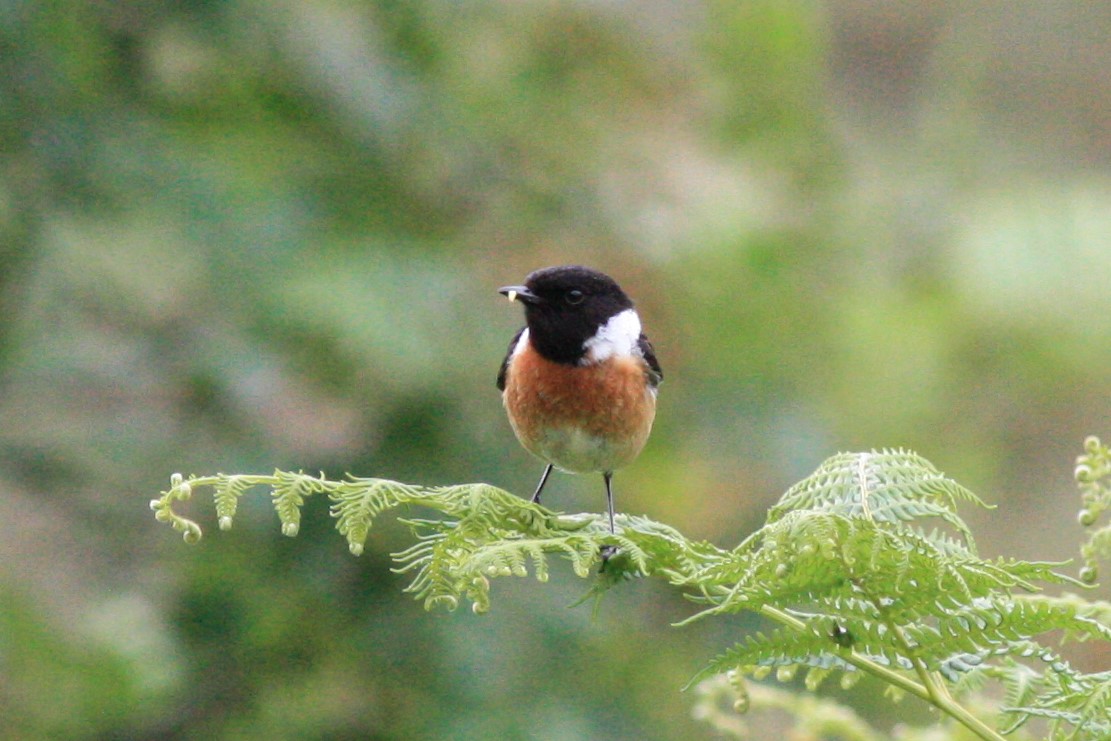
The path did bring us into contact with several families of Stonechats, providing an opportunity to photograph this stunning male bird.
After 6.5km, we were tired and hungry, but we had reached the road bridge that crosses the Rackwick Burn. Here are a couple of small pools where several species can be seen regularly through the flight season. But not today. A chill north-westerly breeze blew across the surface of the water in a most uninviting way. Despondent, I retraced my steps a few metres, to the shelter of some bushes, to hunker down out of the wind and unpack some food for lunch. Halfway through removing my rucksack, one shoulder relieved of its weight, I froze. Not because of the weather, but due to the words in my head, repeating over and over again... 'the shelter... out of the wind'.
There, not a metre from the path, was a Common Hawker dragonfly, perched in the lee of some heather and seemingly unperturbed at my presence. Indeed, not five minutes previously, we had both walked past this point.
I called The Admiral over and, as we marvelled at our good fortune in finding one resting dragonfly in all this habitat, we took loads of photographs and then sat down with our sandwiches, staring contendedly at our new companion.
Though blue in the colouration of its spots, rather than the normal yellow, it was a female. There is an andromorph form of Common Hawker, more frequently encountered in Scotland, and here was an exquisite example.
Later, looking at my photographs, I noticed this pair of spines (on the left) located near the end of her abdomen, possibly protecting her ovipositor or of some other use during mating (?!).
We watched her for ages, until with a short bout of wing-whirring to warm her flight muscles and a toilet break to lighten her payload, she took to the air and disappeared across the heather, out of sight.
Our next target water body was the Rackwick Pool, behind the car park near the beach. However, as we approached it, we realised that there were several Arctic Skuas hunkered down in the heather between us and the pool. Again, not wanting to unnecessarily disturb breeding wildlife, we beat a dignified retreat.
As we wandered back up the road, the Admiral spotted first a Large Red Damselfly and then, by a small pool, an exuvia. Keen eyes, indeed. The exuvia was from a Common Hawker, who knows, maybe even the one we had seen earlier.
As we returned to Moaness along the tarmac'd road, we had no further odo sightings, but my camera recorded that we saw a bumblebee on some Red Clover and a gall on a Willow leaf.
But the day belonged to a serendipitous moment shared with a stunning dragonfly.
Well, here's one from this week!
With a shared passion for Odonata, a bit of rubbish weather wasn't going to keep The Admiral and I from tackling North Hoy, in the quest for dragons and damsels. We took the foot passenger ferry from Stromness to Moaness and set off across the island, headed for the hamlet of Rackwick.
| Courtesy of Ordnace Survey and Geograph |
Setting off again, along the western edge of Sandy Loch, we had good views of Great Skua (Bonxie), as plenty of the local population seem to use the loch for bathing.
A keening raptor call had us scanning the skies for its source. It turned out to be a pair of Peregrine falcons, presumably an adult and a juvenile. No prizes for guessing who was making all the noise.
As we walked through the valley formed by Ward Hill and Cuilags, we searched in likely places for any dragonflies or damselflies, but the coolness of the day and the lack of sunshine severely compromised our chances of finding anything.
The path did bring us into contact with several families of Stonechats, providing an opportunity to photograph this stunning male bird.
After 6.5km, we were tired and hungry, but we had reached the road bridge that crosses the Rackwick Burn. Here are a couple of small pools where several species can be seen regularly through the flight season. But not today. A chill north-westerly breeze blew across the surface of the water in a most uninviting way. Despondent, I retraced my steps a few metres, to the shelter of some bushes, to hunker down out of the wind and unpack some food for lunch. Halfway through removing my rucksack, one shoulder relieved of its weight, I froze. Not because of the weather, but due to the words in my head, repeating over and over again... 'the shelter... out of the wind'.
There, not a metre from the path, was a Common Hawker dragonfly, perched in the lee of some heather and seemingly unperturbed at my presence. Indeed, not five minutes previously, we had both walked past this point.
I called The Admiral over and, as we marvelled at our good fortune in finding one resting dragonfly in all this habitat, we took loads of photographs and then sat down with our sandwiches, staring contendedly at our new companion.
Though blue in the colouration of its spots, rather than the normal yellow, it was a female. There is an andromorph form of Common Hawker, more frequently encountered in Scotland, and here was an exquisite example.
Later, looking at my photographs, I noticed this pair of spines (on the left) located near the end of her abdomen, possibly protecting her ovipositor or of some other use during mating (?!).
We watched her for ages, until with a short bout of wing-whirring to warm her flight muscles and a toilet break to lighten her payload, she took to the air and disappeared across the heather, out of sight.
Our next target water body was the Rackwick Pool, behind the car park near the beach. However, as we approached it, we realised that there were several Arctic Skuas hunkered down in the heather between us and the pool. Again, not wanting to unnecessarily disturb breeding wildlife, we beat a dignified retreat.
As we wandered back up the road, the Admiral spotted first a Large Red Damselfly and then, by a small pool, an exuvia. Keen eyes, indeed. The exuvia was from a Common Hawker, who knows, maybe even the one we had seen earlier.
As we returned to Moaness along the tarmac'd road, we had no further odo sightings, but my camera recorded that we saw a bumblebee on some Red Clover and a gall on a Willow leaf.
But the day belonged to a serendipitous moment shared with a stunning dragonfly.
Subscribe to:
Posts (Atom)