Sunday, 17 July 2016

A reconnaissance with resonance

A midweek free day, a precious gift at any time of year, saw me heading to Hoy to recce sites for a dragonfly walk. Now, you're probably thinking "Isn't any walk during the Summer a dragonfly walk?" and technically you're correct, dear knowledgeable and perceptive reader. However, this walk is for the Orkney Field Club, so I was keen to alleviate a few worries prior to the big day. Nothing too drastic, you understand, just whether the pools were still there (it was very wet last year) and, if so, did they have any odonate presence yet?

Although the weather forecast was for sun in late afternoon, that didn't coincide with either my or the ferry's schedule, so I arrived at Lyness, on Hoy, under cloudy skies which were threatening rain, and set off into a strong southwesterly breeze.

The plan was to climb up to the south-facing slopes of Wee Fea, where a few pools had sufficient promise to be able to deliver the necessary "Wow!" factor. The track from the village wound gently upwards at first, passing a garden bordered with a wonderful Dog Rose hedge. Well, I assume that's what it was, though it did have white flowers rather than the usual pink. The scent was heavenly, and cheered me up despite the gloom overhead. Better a white Dog than a Black one, eh?

As the climb steepened, my attention was grabbed by bird calls coming from a conifer plantation on my left. A family of Siskins were flitting through the pine tops, under the watchful gaze of a low-flying Great Skua (during the couse of the walk, there was a constant stream of Bonxies flying from east to west. OK, it might've been the same one doing laps of Wee Fea, but I don't think so).

Turning to contour around to the southern flank of the hill, the path levelled out. As I passed the ruined concrete starkness of a military communications building, dating from the World Wars, I headed directly into the cold breeze and the first few ominous drops of rain. Let's just say that conditions for spotting odes were... sub-optimal. I pondered that perhaps my best chance of seeing a damselfly would be in the beak of a Meadow Pipit, busy feeding a young family.

When I finally reached the pools, they were still there! OK, they were definitely shallower than last year, but were still of a size and depth to provide suitable habitat for dragons. A preliminary scan across the water surface and bordering vegetation revealed absolutely nothing on the wing, which bearing in mind the conditions wasn't such a surprise. I slowly wandered along the southern edge of the water bodies, hoping for some sign, any sign, that there were odes present.


Narda, not a thing, just one very drowned butterfly, possibly a Blue.

Redoubling my efforts, I retraced my steps, focussing harder on those few places where the emergent vegetation gave some shelter from the weather.

Then, as if a neon sign had suddenly been switched on, there was a bright blue damselfly, right in front of me, clinging to a reed stem. How had I missed that?

Over the next ten minutes, as I stood rooted to the spot, I spotted several more individuals of Common Blue Damselfly, all on the leeward side of the vegetation, hanging on as best they could. Mind you, a few were sufficiently unconcerned to be engaging in a bit of hanky-panky.


Now that I had my eye in, I also managed to identify singletons of Large Red, Blue-tailed and Emerald Damslelfies, which is as many damsel species as you could hope for in this neck of the woods. So to speak. Much heartened that, with some decent weather, any walk in the next few weeks would stand a good chance of odontalogical success, I pottered off back down the hill, worries and cares dropping off me as lightly as dandelion seeds in the wind.


Opposite the afore-mentioned plantation, across some rough pasture, there is another pond. Larger, deeper and much more sheltered, at least from a south-westerly, it is a reasonable water body from which to expect some dragonly return.


For a few fleeting moments, the sun put in an appearance, the sudden warmth enlivening all nature in its beam. There were more Emerald and Blue-tailed Damselflies sheltering in the grass away from the water's edge, whilst a single, recently-emerged Black Darter dragonfly fluttered to higher ground to mature and reduce the threat of predation.


Hurrying back to Lyness, I just had time to pop into the Scapa Flow Visitor Centre and Naval Museum to check a pond situated between the Pumphouse and the Romney Hut. This usually holds Large Reds and Blue-tails, so I was thrilled to also discover an Emerald Damselfly, a species that is quickly establishing itself across Hoy since its arrival in the north west of the island in 2010.

Boarding the ferry, I made my way below deck. Sitting in the passenger lounge, I wrote up notes for this blog, recorded my sightings and checked through a multitude of my photos for anything in focus. Reaching mainland an hour later, as predicted, the sun was out and it was hot. Gah! Not to worry, there be dragons on Hoy!


Bog Asphodel


Common Blue Butterfly

Wednesday, 13 July 2016

Big in Japa... no, wait a minute...

In the last 24 hours, Imperfect & Tense has had an inordinate number of visits from...

When your daily hit count increases by more than 500%, it isn't a good sign (admittedly, whilst I retain the vague hope that it could be a good sign, my scribblings aren't that great).

If only there was a Monty Python song that could explain this phenomenon.

Sunday, 10 July 2016

Frogless blogness

Today's adventure involved driving to Deerness and wandering towards Mull Head, in a vain attempt to find a Frog Orchid. Not to worry, we saw lots of other things instead.

The Grass of Parnassus is in flower. A more exquisite plant, I cannot imagine. It is simply gorgeous.

A Short-eared Owl hunted along the unimproved grassland of the clifftops, searching for Orkney Voles. The tussocks of grass are full of the hidden runs of these rodents.

There were plenty of Common Blue butterflies, wrestling with the wind in their searches for Bird's Foot Trefoil blooms.

On one cliff ledge was a Black Guillemot (Tystie) chick and an egg. None of us could recall ever seeing a Tystie chick before. Until they fledge, they're normally tucked away out of sight in crevices between rocks.

Frog Orchid-less, we finally admitted defeat and sat down on the clifftop by the Brough of Deerness, to watch the to-ing and fro-ing of countless sea birds as they foraged for food.

Around our feet, the sward was full of a small plant with delicate pink flowers. None of us could remember what it was called, though we were pretty sure it wasn't a Frog Orchid.

Back home, the ID guides were perused until we solved the mystery...


Sea Milkwort, Glaux maritima (featured before in these pages, so I really had no excuse for not knowing).

Our Lass had suggested that perhaps it was a Pimpernel? I could see where she was coming from, the flower is reminiscent of Scarlet Pimpernel. But I knew it wasn't any of the British members of this family (Scarlet, Yellow or Bog). I shouldn't have been so scathing, as when we finally tracked down the ID, we discovered that both Sea Milkwort and the Pimpernels are in the same family, Primulaceae.

Saturday, 9 July 2016

Random photos from this weekend

We have The Admiral visiting Tense Towers at the moment, so this morning was an opportunity to slip into tourist mode and search out a walk that would be new to all of us. From a short list of four stretches of South Ronaldsay coast, Our Lass chose the section from Windwick to St Peter's Kirk, Eastside, a linear walk along cliff tops and a sandy beach.

From the small car park at Windwick, the view was immediately pleasing, especially as rain was forecast to arrive by lunchtime.


If I'm reading the map correctly, the sea stack on the right is the Clett of Crura.

The going along the cliff tops was interesting...


Unashamedly interesting...


But the buttercups kept us on the straight and narrow...


The folds and inclines of the rock are a story that is beyond my ability to read, but the fulmars seem to be central to the plot.


I was struggling with plenty of plant names too. This is a species of vetch, but which one is it?


Though I do know that this is Gunnera, I'm just not sure it's native to Orkney!

Eventually we arrived at Newark Bay, with its expanse of sandy beach.


Our destination was St Peter's Kirk, seen on the right at the other end of the bay.

But there was still time for a few more surprises...


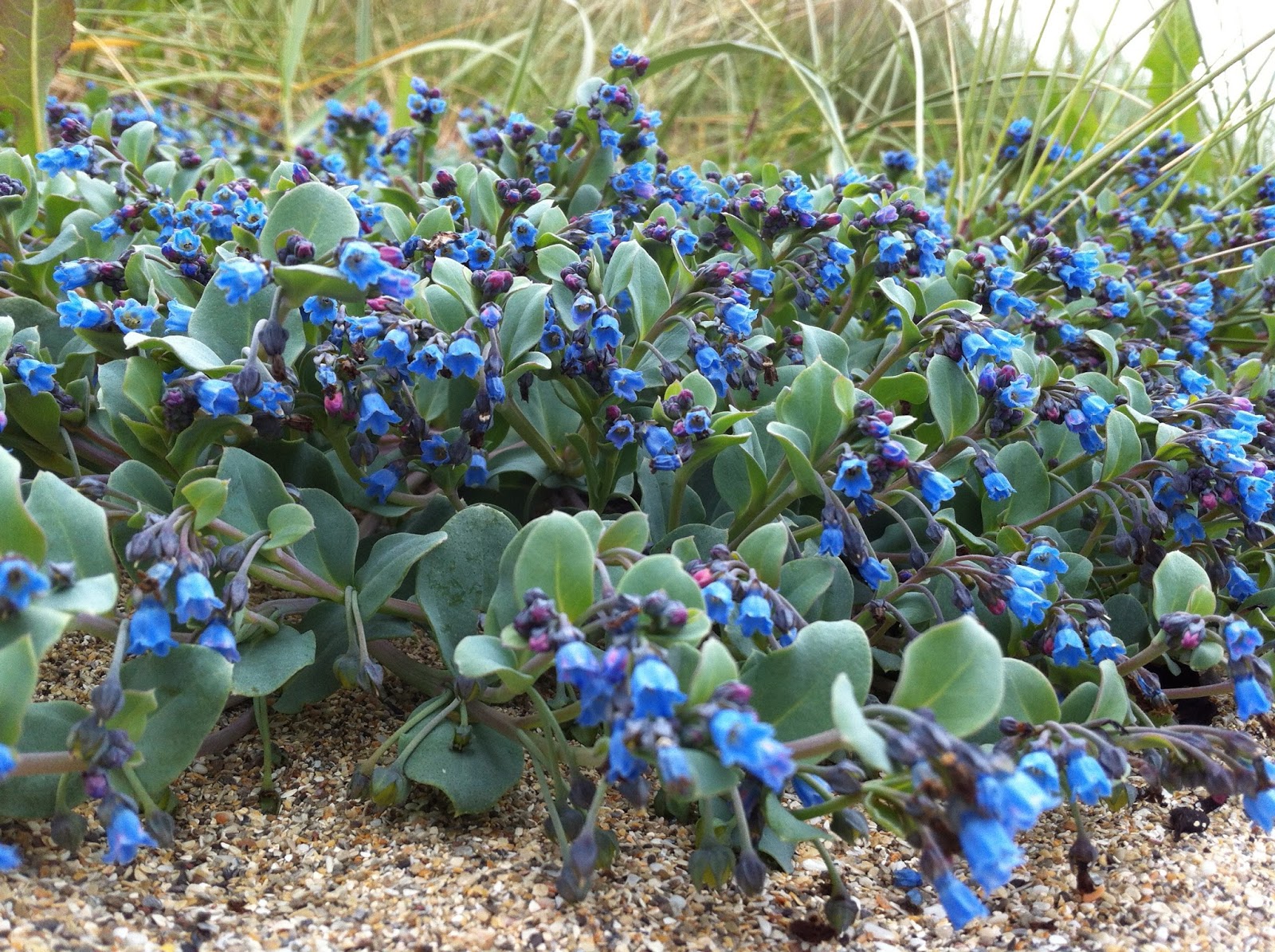
Oysterplant, Mertensia maritima, is rare nationally, but does rather well in Orkney, and Newark Bay has several clumps along one particular stretch of beach.


And just as we were about to leave the beach, I picked up this bit of plastic which was sticking out of the sand. Later enquiries, with clever folk who know about this sort of thing, revealed that this is a lobster creel tag from the northern tip of Nova Scotia in Canada, dating from 1991. And still readable after 25 years! As it only takes about 18 months for the Gulf Stream to carry stuff across the Atlantic, it may have been buried on this beach for most of that time.

That needed some thinking about, so we adjourned to a local bistro for lunch and a bit of cogitation.

Friday, 8 July 2016

Random photos from a previous weekend

Part of a young Monkey Puzzle tree - Olaf's Wood, Windwick

Cotton grass and cottonwool clouds - Glimps Holm

Hoverfly on flag iris - Olaf's Wood, Windwick

Tuesday, 28 June 2016

45 minutes of time travel

Yesterday, I was working on Papa Westray, one of the northern isles of Orkney. Once my task was complete, I had about three quarters of an hour to wait before the peedie plane was due, to whisk me back to Kirkwall. This was just enough time to wander around a small loop, taking in Holland Farm, the Knap of Howar, a bit of shoreline and the Old Kirk.


At Holland Farm, the slurry tank has an enigmatic emblem emblazoned upon it. This is a copy of some Norse graffiti, the 'Dragon', which can be found in the Maes Howe chambered cairn on the mainland.

Also at the farm, in one of the fields, are these piles of stones...


which I presume were once used for drying crops?

As I walked down to the west coast, I had to cross a pasture full of cattle. They were much more interested in grazing than gazing at the view, or at me.


Then it was a brief visit to the Knap of Howar...


before pottering along the shore to the Old Kirk (St Boniface).

Once back on the 'main' road, the view to the east was of the Holm of Papay, with a few yachts anchored in the bay.


And then back to the airfield, where the boundary walls feature an uneasy alliance of lichen and warning paint.


This heady mix of past and present is a theme widespread in Orkney and not confined to Papa Westray, but this short walk certainly brought it to the fore.

The deafening sound of dust settling

Unless, by some strange quirk of fate, you have avoided all media for the past week and solely rely on Imperfect and Tense for your current affairs input, you will have probably heard that, in a referendum of its population, the UK has voted to leave the EU. How very quelle surprise.

As in all things, it's not quite as straight forward as that, mind. For although the combined results put the Leave camp on 52% and the Remain camp on 48%, England and Wales voted to offski from the EU, whilst Scotland and Northern Ireland voted to stay.

The campaigns fought by both sides were rather negative, with some downright lies hoisted upon the populace as complete facts. How that isn't illegal, I do not know? Is there any other walk of life where you would be allowed the unbridled freedom to con folk to such an extent? Well, apart perhaps from those pedlars of landline broadband with their 'up to bazillions of Mbps' on offer.

I steered clear of the televised debates. Politicians trying to shout each other down is such an unedifying spectacle, the only winners, I suspect, being ear defender manufacturers.

Predictably, my own view on the referendum was governed by the best outcome for wildlife, which put me firmly in the Remain camp. Not that the environment featured anywhere in the whole debate to any great extent. However, whatever your view of the EU, its Habitats and Birds Directives provide an amount of protection for the ecology of a continent. And I do not think anyone has any great hopes of a deregulated UK giving a second thought to concreting over vast swathes of Nature.

Now that the people of the UK have spoken, it will take some time for the situation to resolve itself, as there doesn't appear to be a Plan B. And, I suspect, there wasn't a Plan A either, beyond trying to bluff the EU into yet more concessions and change the leadership of the Conservative party.

So, with the pace of change and the multitude of pressures upon the environment increasing, the natural world will go back to doing what it does best, evolving to cope as best as it can.